A Bio-Based Temporary Housing System for Northern New South Wales
This project developed a low-cost, prefabricated temporary housing system made primarily from recovered waste cardboard and under-utilised timber sourced from Northern New South Wales (NSW). It aimed to increase the use of renewable and recycled materials in temporary housing, and to support regional manufacturing of bio-based modular housing systems.
The project brought together government, research, and industry partners from every stage of the value chain, from forestry resources to engineered wood products and housing. Partners contributed materials, technical knowledge, and manufacturing expertise, which shaped housing designs suited to low-carbon and scalable delivery for regional disaster recovery.
Housing System
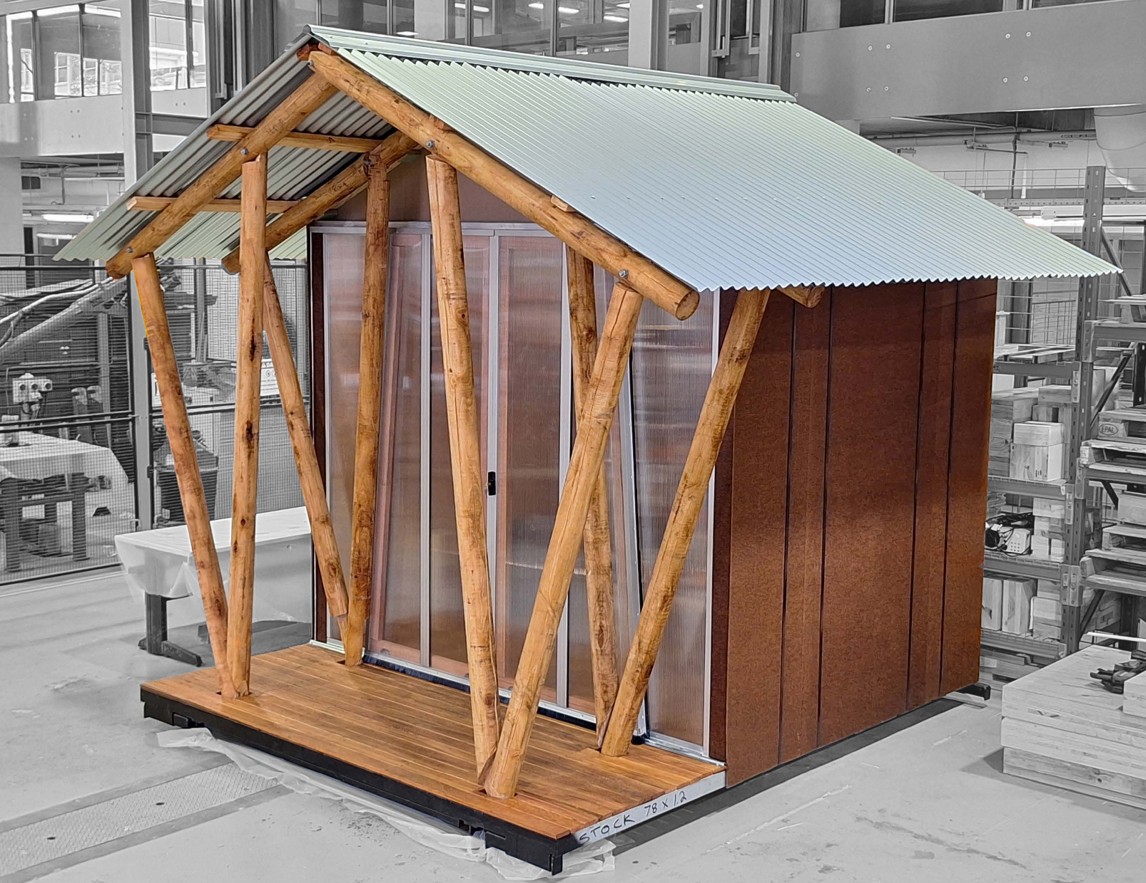
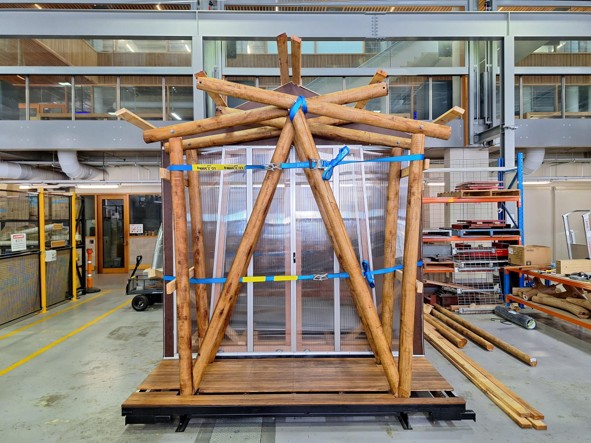
The project produced three outcomes. Hybrid timber-cardboard sandwich panels were designed and fabricated from recycled cardboard and a mix of wood-based panels (plywood, particleboard, and MDF), with manufacturing protocols and costing data refined through partner feedback. A deployable roundwood framing system was developed from small-diameter thinning poles and low-cost ratchet straps, for rapid assembly and disassembly. The two systems were then combined in a full-scale 11 m² prototype emergency dwelling, which demonstrated transportability, ease of assembly, and the practical requirements of post-disaster housing.
Community Showcase
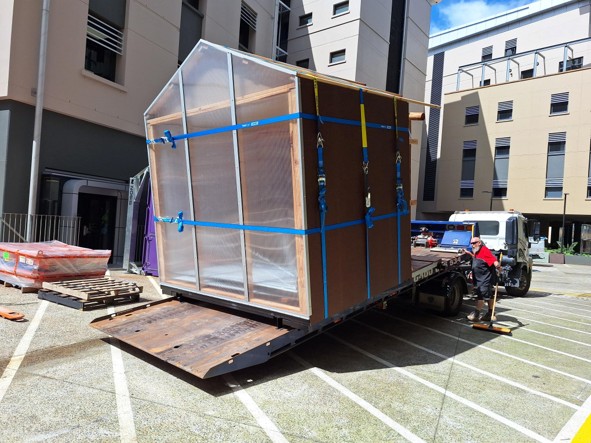
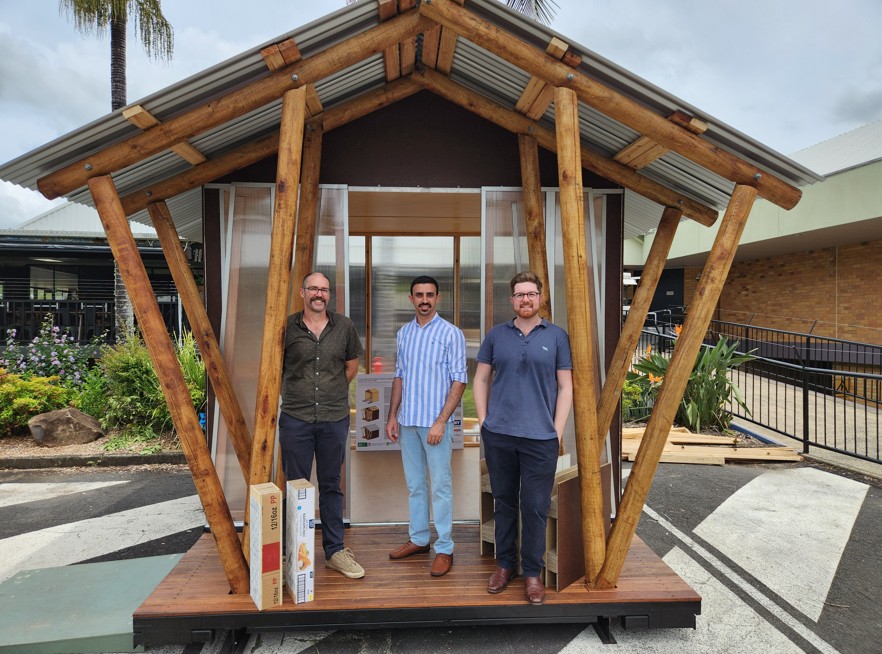
The prototype was exhibited in Lismore through public drop-in sessions, where members of the disaster-affected community gave feedback on the design. The dwelling was transported on a tilt tray truck, then disassembled and reassembled with basic tools by four people in around three hours. The showcase drew public and media interest from November 2024 to January 2025. Further coverage followed from February to May 2025, after the prototype weathered Cyclone Alfred in Brisbane.
Cost and Embodied Carbon
The Australian market for small-footprint dwellings is growing, but varies widely in cost and construction system. A pricing comparison with five dwellings available at retail found the bio-based prototype comparable in cost to timber-framed and foam-core structural insulated panel systems, lower in cost than imported timber houses, and within the cost range of steel-framed systems.
The upfront embodied carbon of the bio-based system is approximately 90 kg CO₂e/m² lower than that of current steel-framed housing systems, and comparable to timber-framed systems in both embodied carbon and stored biogenic carbon. Steel framing remains the dominant temporary housing solution in Northern NSW and for other small-footprint dwellings. For an average 30 m² dwelling, substituting the bio-based system for steel framing could reduce upfront embodied emissions by approximately 2.7 t CO₂e. Around 4,300 small-footprint dwellings are built in NSW each year; using the bio-based panel system for half of them could reduce upfront embodied emissions by an estimated 5,800 t CO₂e per year. End-of-life disposal to local landfill, reuse, and recycling are all feasible, although whole-of-life comparisons with existing systems remain uncertain because the prototype is temporary.
These results set a benchmark for the cost, material use, and carbon footprint of the system, to support further design refinement and pathways to commercialisation.
Partners: Hurford’s, Australian Panels, Weathertex, Big River, Forestry Corporation of NSW, Visy, Jowat Adhesives, , Ausco Modular, and NSW Decarb Hub.
Funding: NSW Decarbonisation Innovation Hub, Land and Primary Industries Network.
Other Project Pages:
- Southern Cross University (2024). Sustainable ‘cardboard’ homes: a post-disaster housing solution?
Further Information:
- Abu-Saleem, M., Baber, K., Gattas, J., Rose, A., and Ximenes, F. (2025). A low-carbon and bio-based emergency housing system for Northern NSW: final report. The University of Queensland. DOI: 10.14264/f484560
- Abu-Saleem, M., Baber, K., Gattas, J. M., Gilbert, G., Le Bihan, M., Rose, A., and Ximenes, F. (2025). Aligning needs and sustainability: a case study of biobased temporary housing. In World Conference on Timber Engineering (WCTE 2025). DOI: 10.52202/080513-0336
- Abu-Saleem, M., and Gattas, J. M. (2025). Design and optimisation of timber-cardboard sandwich panels for temporary housing applications. In Proceedings of the 18th East Asia-Pacific Conference on Structural Engineering and Construction (EASEC 2024). Springer. DOI: 10.1007/978-981-96-9917-9_47