Forest to Fibre to Building
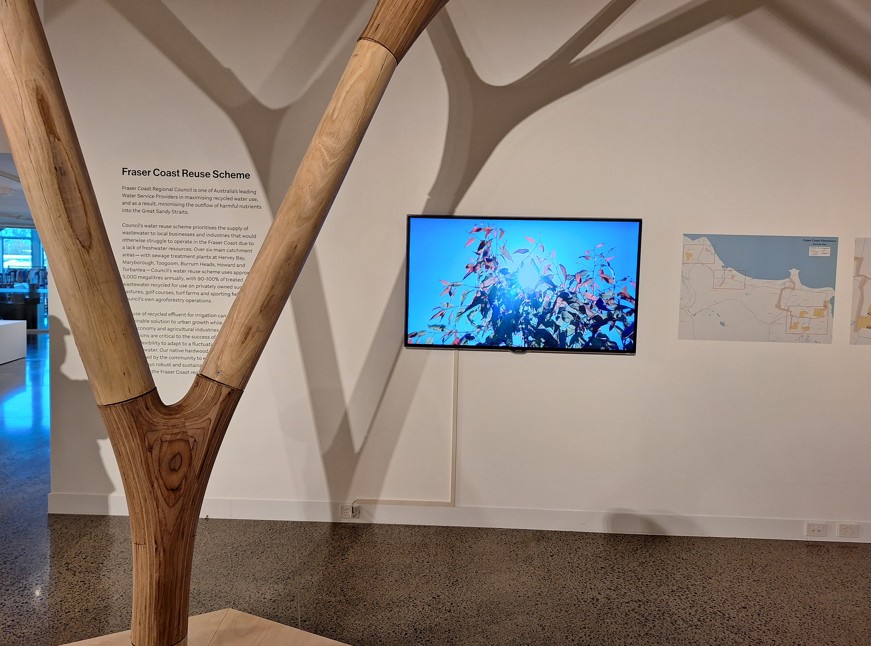
Forest to Fibre to Building is a research pavilion that explores how timber thinnings can be turned into building structures with parametric design. Thinnings are small-diameter logs removed from plantations to improve the growth of the remaining trees, and their small diameter and taper make them low in value for conventional construction. The project used hardwood thinnings from plantations near Hervey Bay that are irrigated with treated wastewater.
Design
The pavilion applies the Lab’s research on inventory-constrained design, using minimally processed round logs close to their natural dimensions. A digital form-finding model starts from an inventory of the available logs, with their measured lengths and diminishing diameters, and uses combinatorial equilibrium modelling to assign each log to a position in a branched column structure. The branched form suits the logs, as it benefits from members whose diameter diminishes along their length.
The connection nodes were designed with parametric modelling and digital fabrication to resolve the non-coplanar intersections between round logs. Each node is a bespoke lamination of alternately mitred LVL lamellas from waste material billets, laminated about a primary arm so that the grain of each node arm aligns with its compressive load path and with the grain of the connected log. The mitred arms give a semi-rigid connection with high moment resistance, and because each lamella is cut close to the size of the finished part, little timber is wasted.
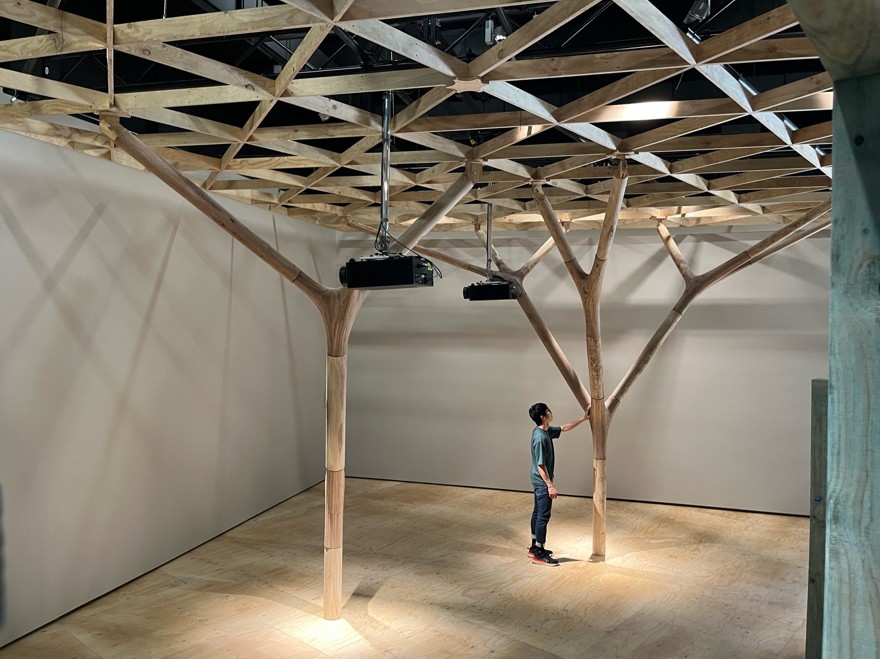
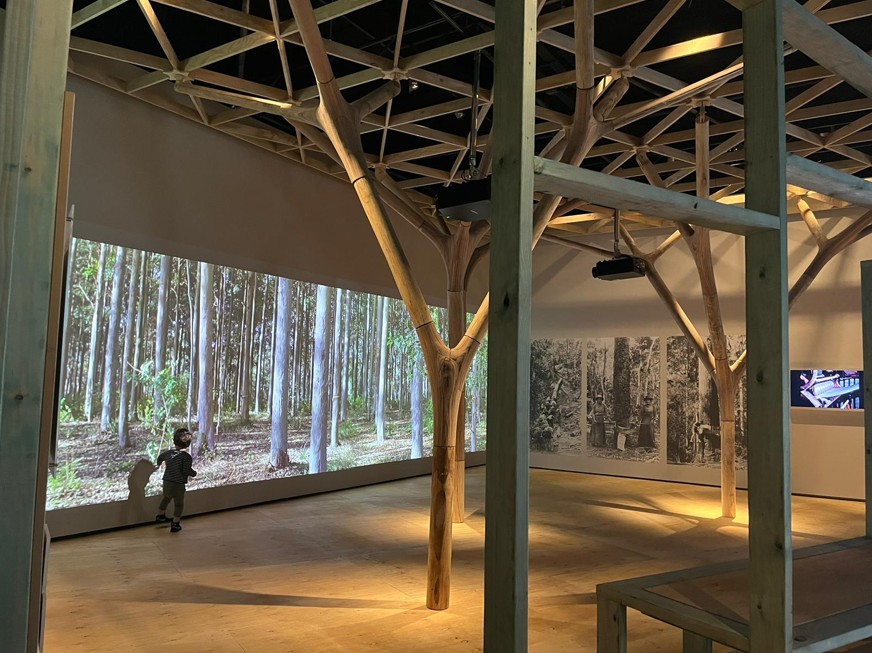
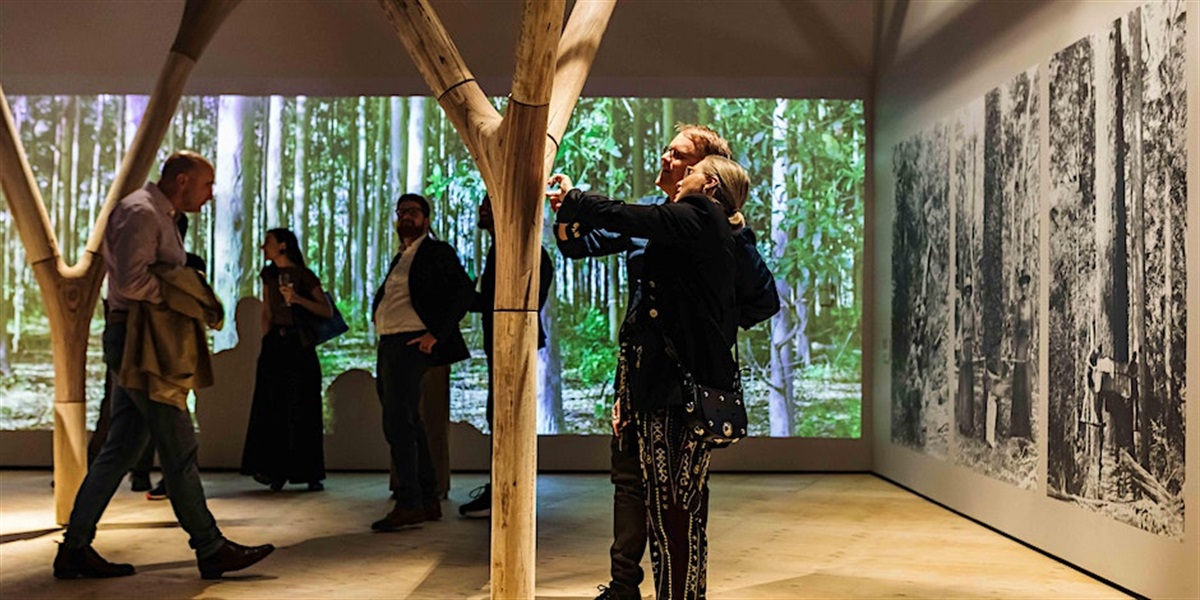
Exhibitions
The pavilion was first shown in Purpose Built: Architecture for a Better Tomorrow at the State Library of Queensland, from 2 September 2023 to 14 April 2024. The exhibition, a joint initiative of the University of Queensland and State Library of Queensland, presented large-scale installations from five UQ research projects, and was among the State Library’s most visited exhibitions. The project team was nominated for the UQ Research Culture Awards (Public Engagement).
The pavilion was subsequently exhibited at the Hervey Bay Regional Gallery in 2024, bringing the project to a regional audience in the area where its timber was grown.
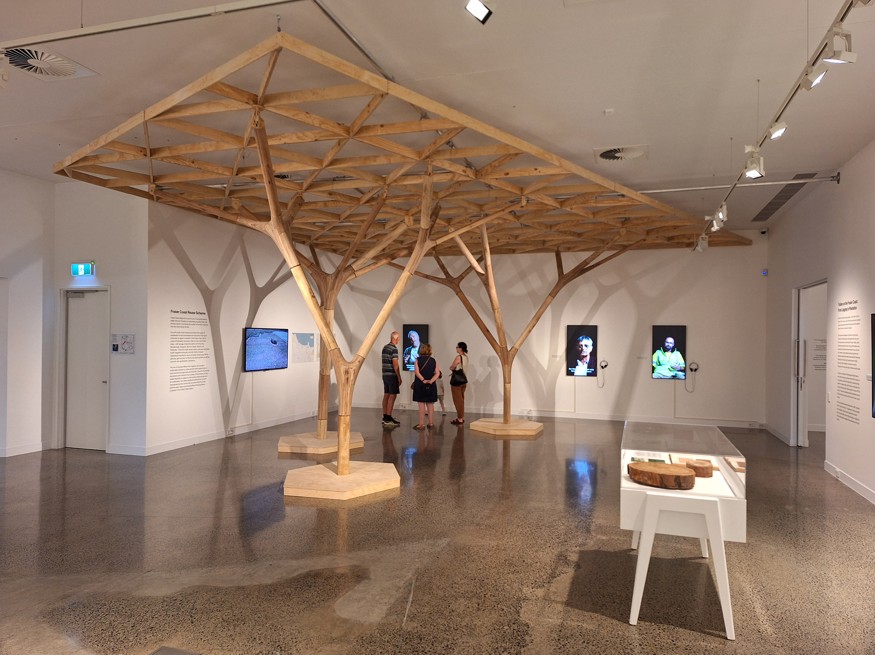
Project Team: Kim Baber, Aaron Barton, Jane Burry, Canhui Chen, Joe Gattas,Cathy Keys, Christoph Koch, Hengyi Ren.
Partners: State Library of Queensland, Fraser Coast Wide Bay Water, Hervey Bay Regional Gallery, FARM Architectural, and ARC Advance Timber Hub.
Other Project Pages:
- State Library of Queensland. Purpose Built: Architecture for a Better Tomorrow
- Wood Central (2023). Discover ‘Purpose Built’ timber exhibit at Qld State Library
Further Information:
- Baber, K. R., Barton, A., Burry, J. R., Chen, C., Gattas, J. M., Koch, C., and Ren, H. (2023). Inventory-constrained design of a variable small diameter round timber structure. In Proceedings of IASS Annual Symposia 2023, Melbourne, Australia.
- Chen, C., Baber, K. R., Gattas, J. M., Ny-Gaard, C. A., and Burry, M. (2025). From wastewater to building: harnessing digital fabrication for circular economy innovations. In Proceedings of the 30th International Conference of the Association for Computer-Aided Architectural Design Research in Asia (CAADRIA 2025). DOI: 10.52842/conf.caadria.2025.3.427
- Baber, K., Chen, C., and Gattas, J. M. (2025). Laminated nodes for a round timber structure. In World Conference on Timber Engineering (WCTE 2025). DOI: 10.52202/080513-0109
- Feng, Y., Ren, H., Baber, K., Chen, C., Yuan, X., and Gattas, J. M. (2025). Inventory-constrained design method for whole tree use in branching canopy structures. In World Conference on Timber Engineering (WCTE 2025). DOI: 10.52202/080513-0487