Computational Structural Design
Part of the Computational Design & Fabrication research theme.
Computational methods can make structural design faster, more reliable, and better informed by data. Research in the Lab develops parametric design frameworks and design automation tools for building design, primarily for timber and steel structures. Related work on capturing data from existing structures is described under Scanning and Sensing.
Parametric Design for Timber Framing Span Tables
Structural sawn timber in residential housing is specified from timber framing span tables, which are published as fixed printed formats. A parametric design framework instead created structured and indexable span data sets from the decoupled evaluation of structural member capacities and building design actions. Because the span data was digital, it could be queried and exchanged directly by design and specification software. The framework was used to investigate how span capacity was influenced by revisions to building practice, and to develop alternative span table formats that allowed cross-grade comparison and minimum-grade specification, reducing the over-specification of timber products in housing construction. Further information: DOI:10.1080/14488353.2023.2227432.
This work has contributed to the development of TimberAS, an open-source Python package for the design of Australian timber structures. Further information: TimberAS.

Steel Connection Design Automation
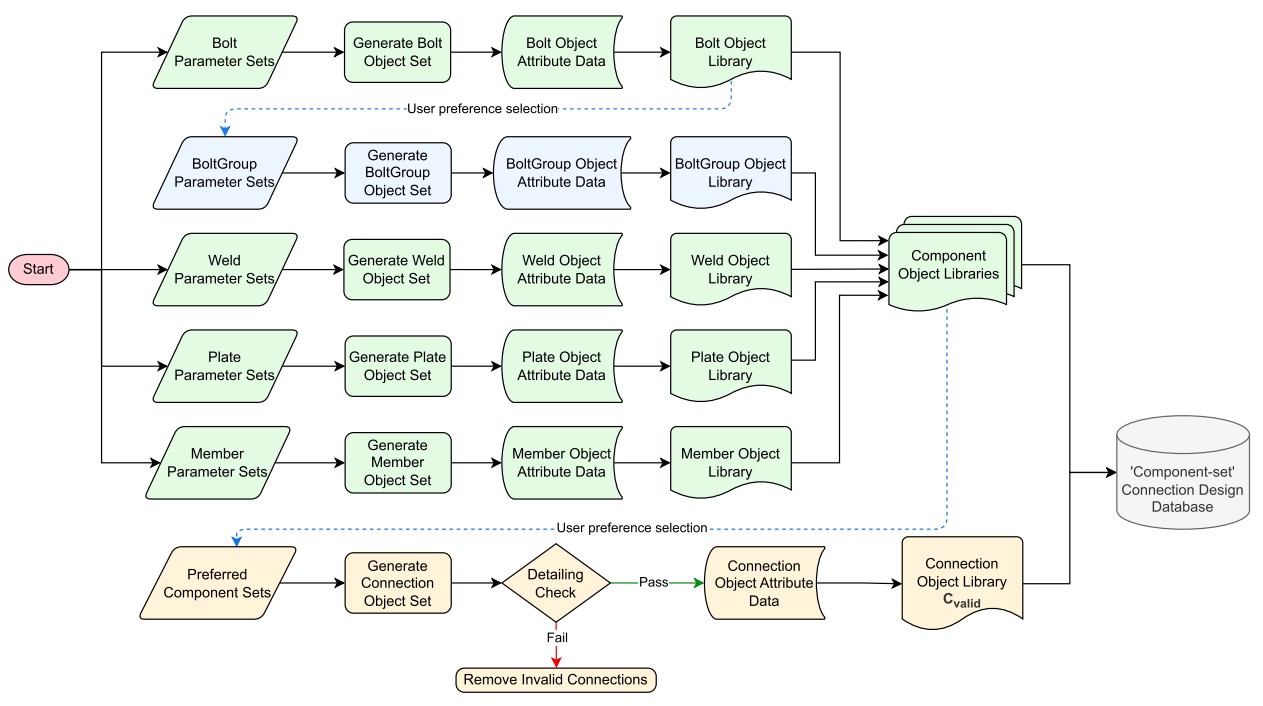
Computational tools for steel connection design usually take a point-based approach, re-evaluating the design whenever specifications change. A set-based design framework instead generated the full design space of connections from all possible component combinations, identified valid configurations automatically, and stored them in a database for rapid, preference-based comparison and selection. Applied to a steel floor system with 62 connections, the set-based approach designed all connections in under 55 milliseconds, more than ten times faster than the equivalent point-based approach. Further information: DOI:10.1016/j.compstruc.2024.107366.
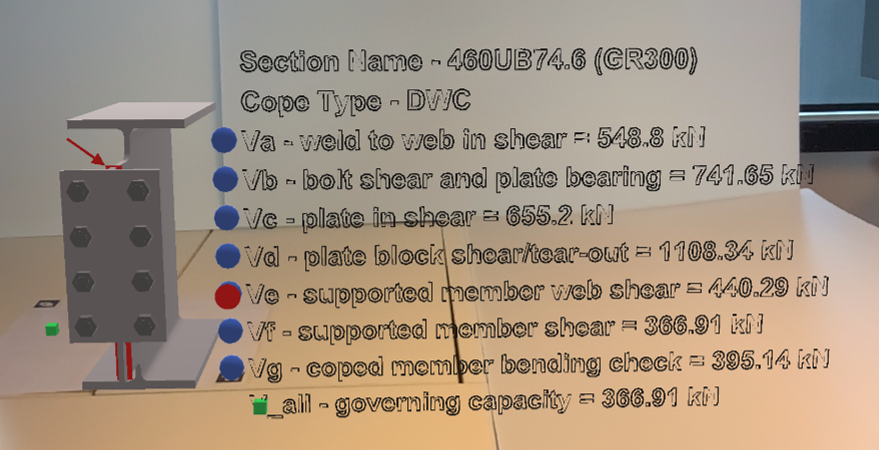
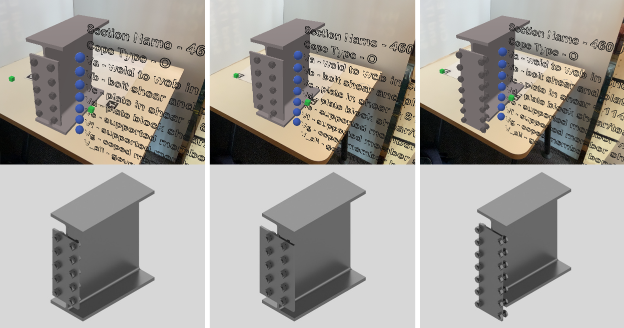
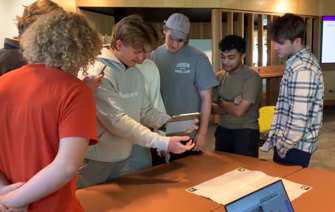
Related work developed a web-based API for the parametric design of Australian steel structures (DOI:10.1007/978-981-96-9917-9_50), and used augmented reality for interactive value engineering of structural steel connections (Proceedings of the IASS Annual Symposium 2023). The augmented reality approach has also been applied to teaching steel design at UQ, with an interactive tool that allowed students to explore full-scale 3D models of steel connections, their load paths, and failure modes. The tool received the 2025 Institution of Structural Engineers (IStructE) Excellence in Structural Engineering Education Award, which is presented to a single recipient worldwide each year.
This work has contributed to the development of SteelAS, an open-source Python package for the design of Australian steel structures. Further information: SteelAS.
Code and Software
 SteelAS
A Python package to support research and design of Australian steel structures
 TimberAS
A Python package to support research and design of Australian timber structures
Related Publications
Gattas, J. M., Ottenhaus, L.-M., Liu, H., & Xie, Y. M. (2025). Design and optimisation of timber-framed structures using a stock of reclaimed elements. Automation in Construction, 180, 106527. https://doi.org/10.1016/j.autcon.2025.106527
Bravo, T., Mills, H., Maluk, C., & Gattas, J. M. (2025). Interactive parametric structural design and optimisation tool for design of FRP-reinforced mass timber buildings. In World conference on timber engineering 2025 (pp. 2374–2380). World Conference On Timber Engineering 2025. https://doi.org/10.52202/080513-0289
Wang, Y., & Gattas, J. M. (2025). A web-based API for parametric design of australian steel structures. In Proceedings of the 18th east asia-pacific conference on structural engineering and construction, volume 2 (pp. 375–382). Springer Nature Singapore. https://doi.org/10.1007/978-981-96-9917-9_50
Gattas, J. M., Reid, C., Dakin, T., Shanks, J., & McGavin, R. L. (2024). Board assignment heuristics for nail laminated out-of-grade timber. Australian Journal of Civil Engineering, 1–14. https://doi.org/10.1080/14488353.2024.2403049
Wang, Y., Bottazzi, V. S., & Gattas, J. M. (2024). A novel framework for set-based steel connection design automation. Computers & Structures, 298, 107366. https://doi.org/10.1016/j.compstruc.2024.107366
Jiang, J., Ottenhaus, L.-M., & Gattas, J. M. (2023). A parametric design framework for timber framing span tables. Australian Journal of Civil Engineering, 1–16. https://doi.org/10.1080/14488353.2023.2227432
Wang, Y., Bottazzi, V. S., & Gattas, J. M. (2023). Using augmented reality for interactive value engineering of structural steel connections. In Proceedings of IASS annual symposia (Vol. 2023, pp. 1–12). International Association for Shell; Spatial Structures (IASS).
Ya, O., Fernando, D., Sriharan, J., Gattas, J. M., & Zhang, S. (2021). A nonlinear beam-spring-beam element for modelling the flexural behaviour of a timber-concrete sandwich panel with a cellular core. Engineering Structures, 244, 112785. https://doi.org/https://doi.org/10.1016/j.engstruct.2021.112785