Digital Fabrication
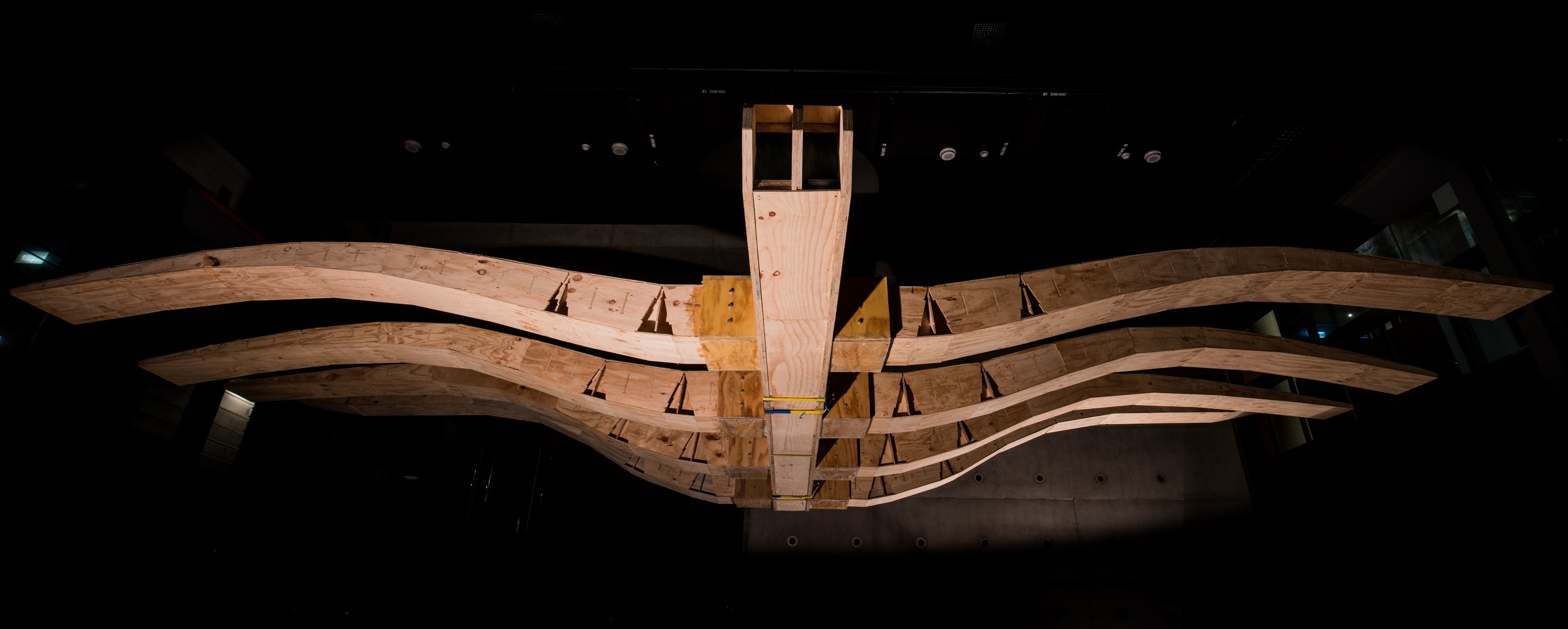
Part of the Computational Design & Fabrication research theme.
With the rapid spread of low-cost CNC manufacturing machines, building designers are increasingly able to use digital fabrication techniques to streamline the design-to-fabrication process. This streamlining comes from the direct integration of computer-aided design (CAD), computer-aided manufacture (CAM), and CNC machinery processes, with key benefits being increased design flexibility and direct control of manufactured elements. Construction time and cost can also be reduced, as a digitally fabricated building element can carry part identifiers, assembly information, or integral joints.
Digital fabrication research in the Lab develops computational design-to-fabrication methods for lightweight, portable, and low-cost structural systems. Related work on designing structures from under-utilised timber is described under Resource-Adaptive Design.
Folded Sandwich Structures
Folded sandwich structures were developed by attaching faceted face sheets to a folded plate core. The faceted faces gave continuous edge connections between the core and face layers, and allowed rigid, unbent sheet materials to be assembled into curved geometries for ultra-light architectural-scale construction. Further information: DOI:10.1016/j.autcon.2015.12.002.
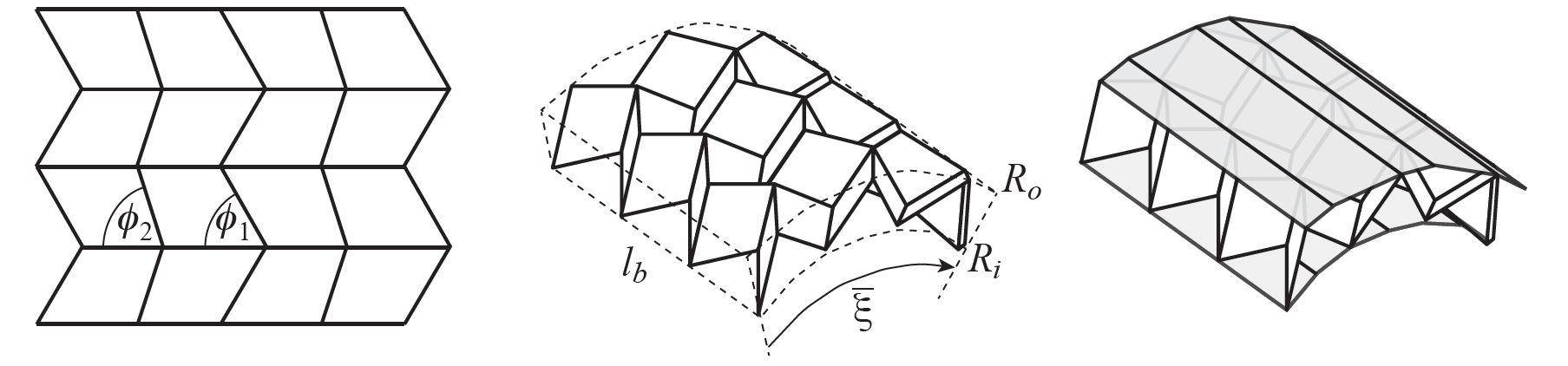
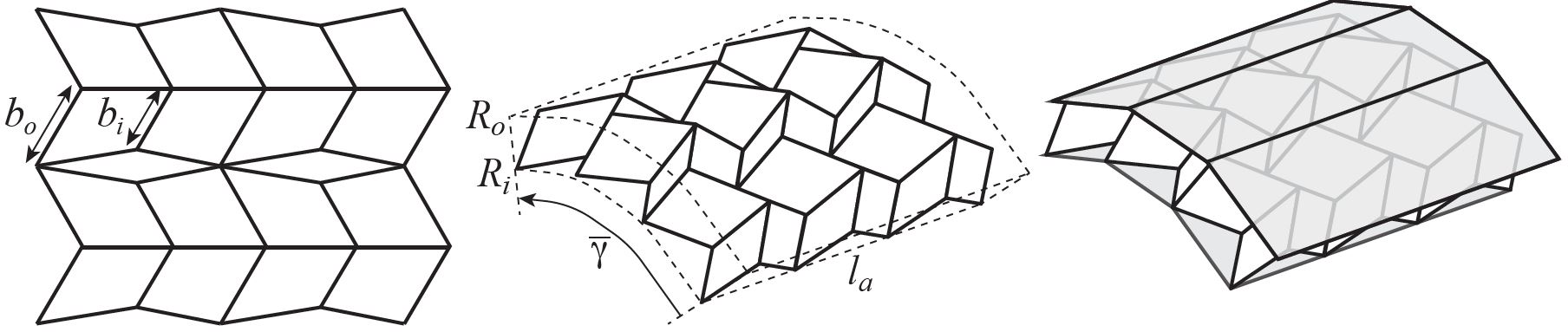
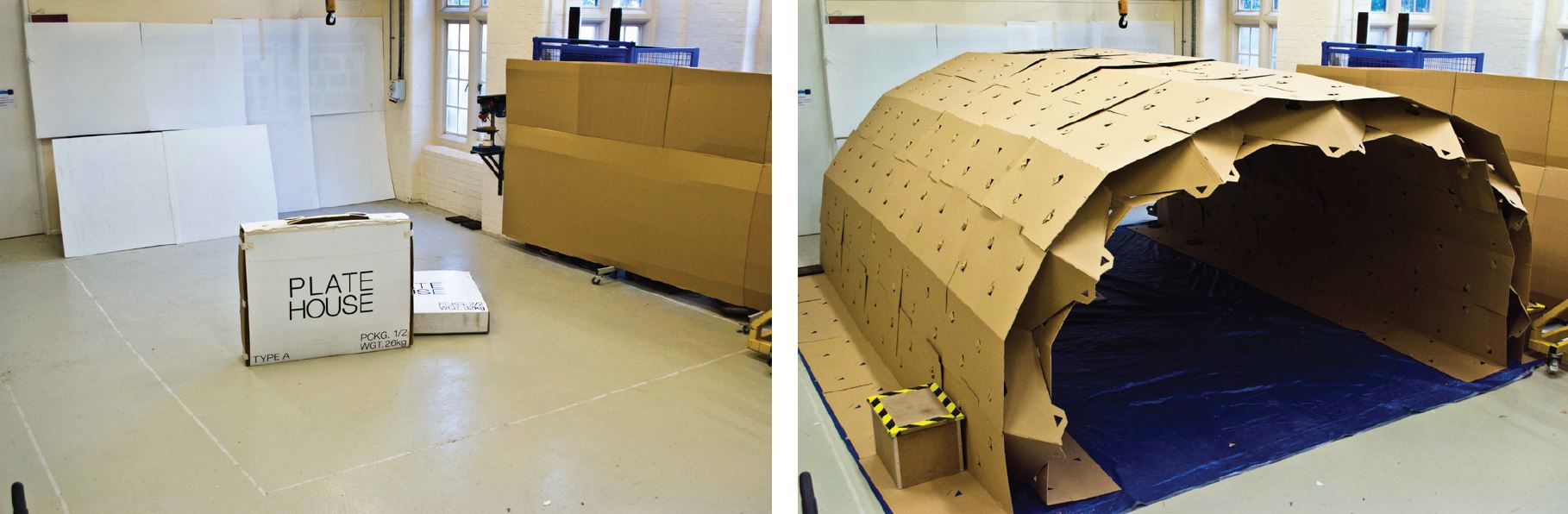
Folded Timber Sandwich Structures
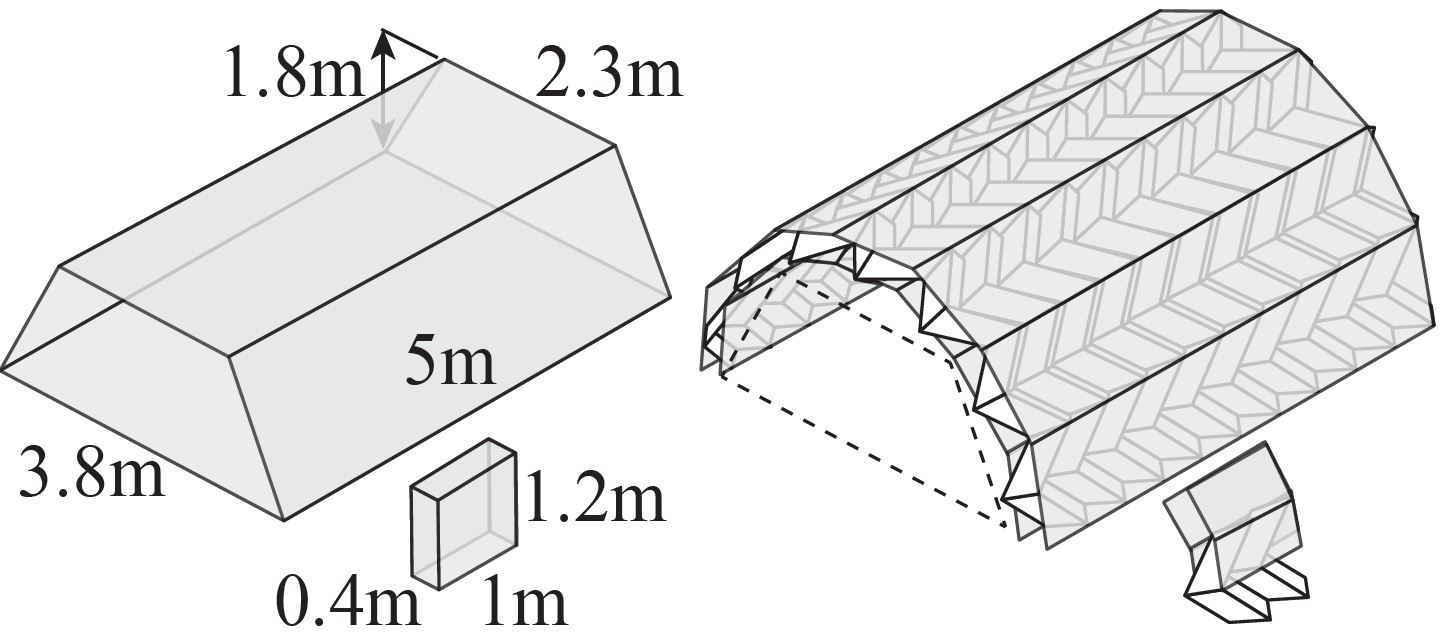
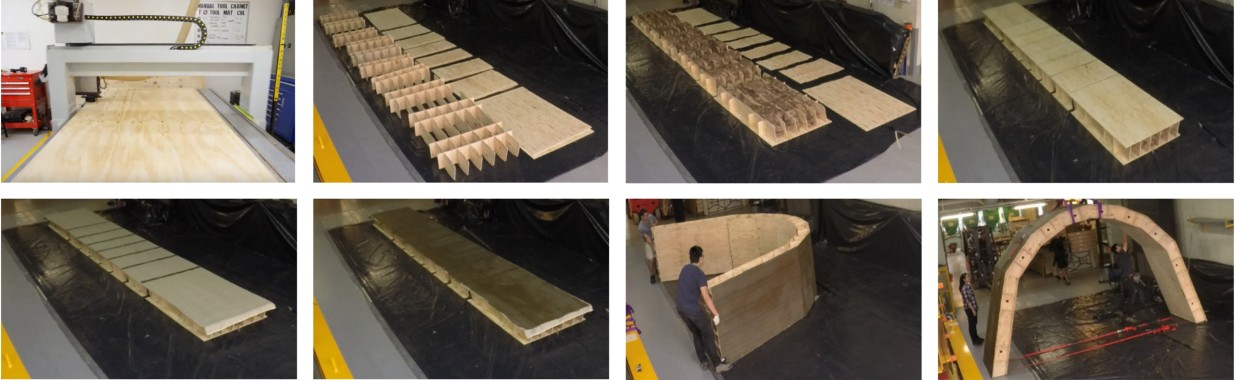
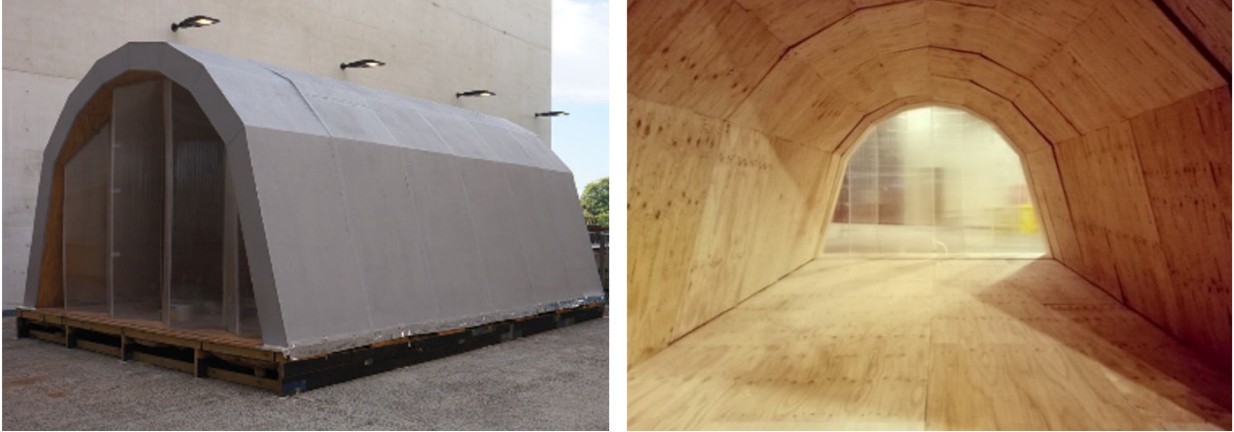
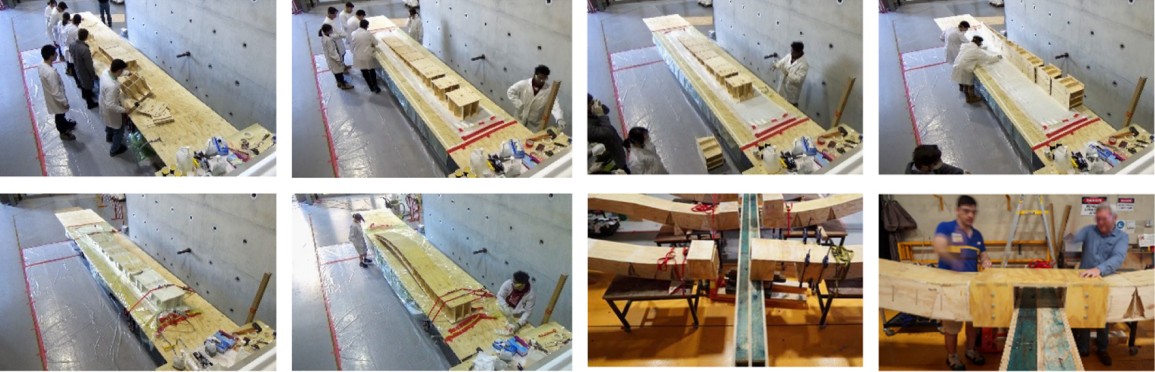
Folded timber sandwich structures combined folded assembly with integral mechanical joints for modular timber construction. Their design-to-fabrication process included methods for segmenting and unfolding building profiles, and for fabricating timber sandwich panels with press-fit and rotational press-fit (RPF) joints. The process was validated by constructing a 30 m² house and a 42 m² canopy, both assembled quickly and accurately. 3D scanning and defect analysis confirmed the precision of the structures: most surface errors, and most angular defects in the RPF joints, were small. Further information: DOI:10.1016/j.autcon.2019.01.008.
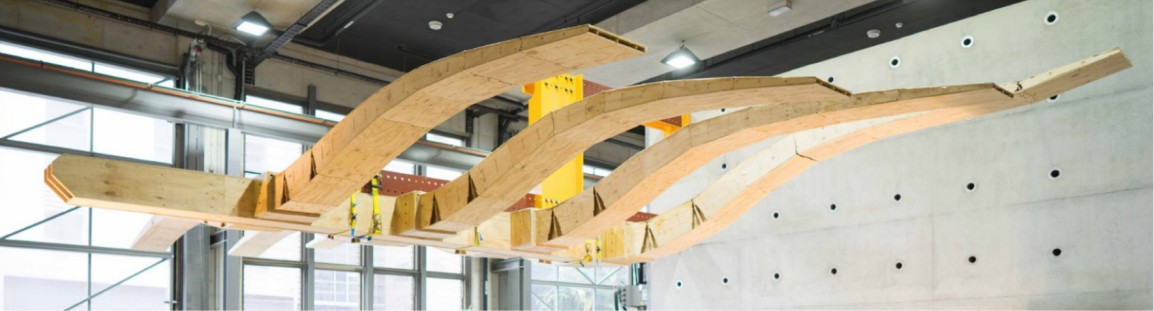
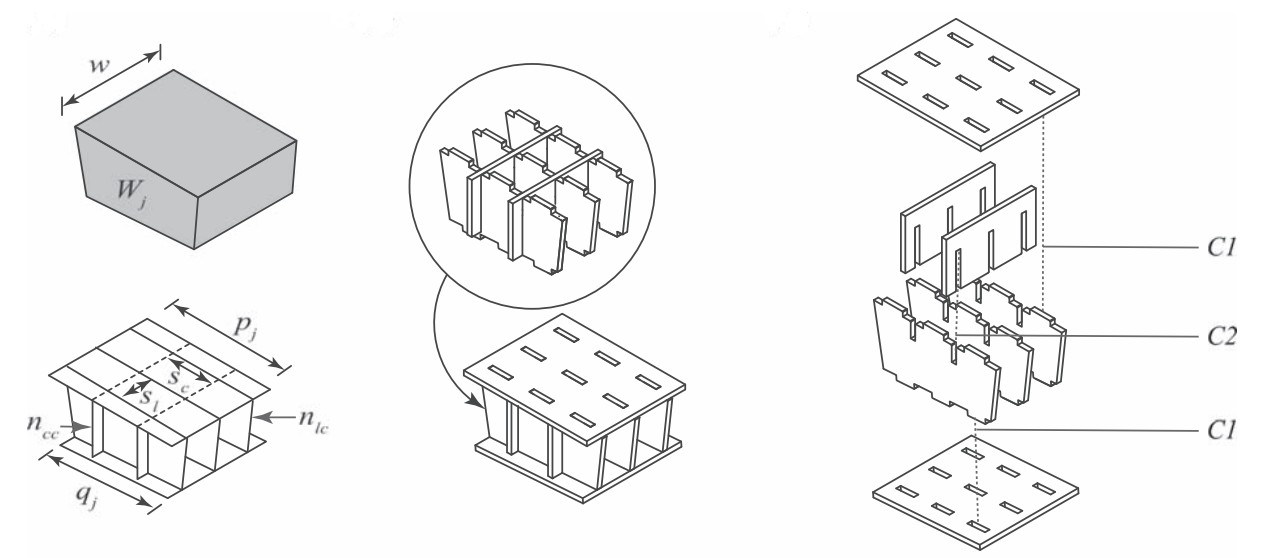
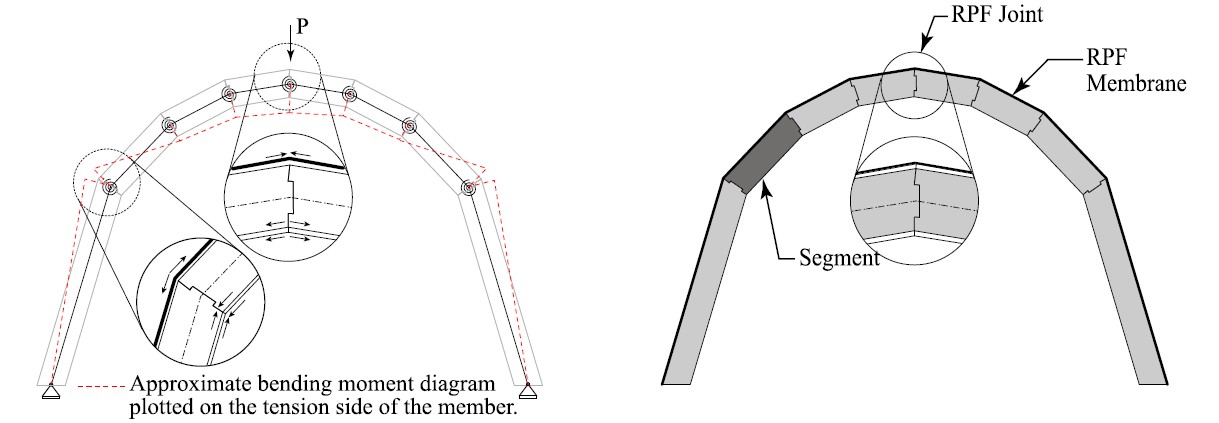
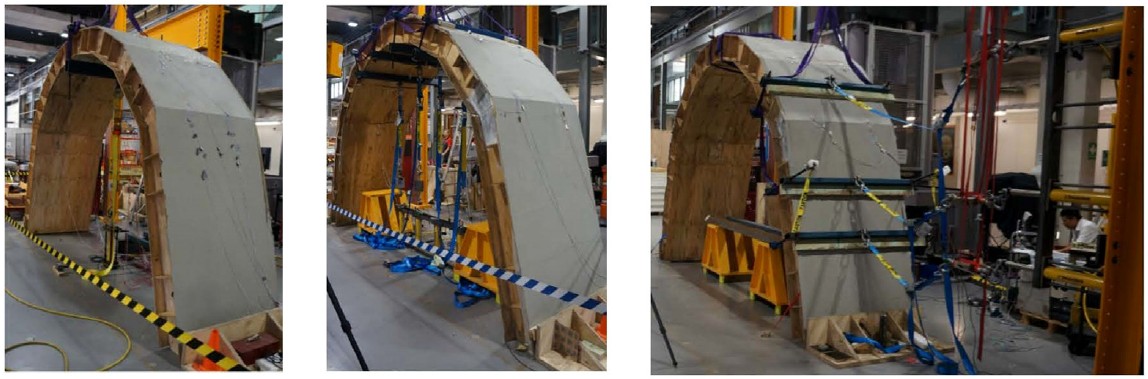
The mechanical behaviour of folded timber sandwich structures with RPF joints was then tested on six arches, under varied load cases that induced sagging and hogging at internal joints. The experiments revealed failures at joints under maximum hogging moment, of two types: FRP tensile fracture and core compressive rupture. A nonlinear static analysis and a simplified 2D frame model were proposed to predict these failures. The model treated the RPF joint as a nonlinear semi-rigid hinge with a bilinear moment-curvature relationship, derived from joint strain data recorded during testing. Core compressive failures were attributed to inelastic core buckling caused by misalignment of core segments. Further information: DOI:10.1016/j.tws.2021.108345.
Post-Tensioned Deployable Timber Structure
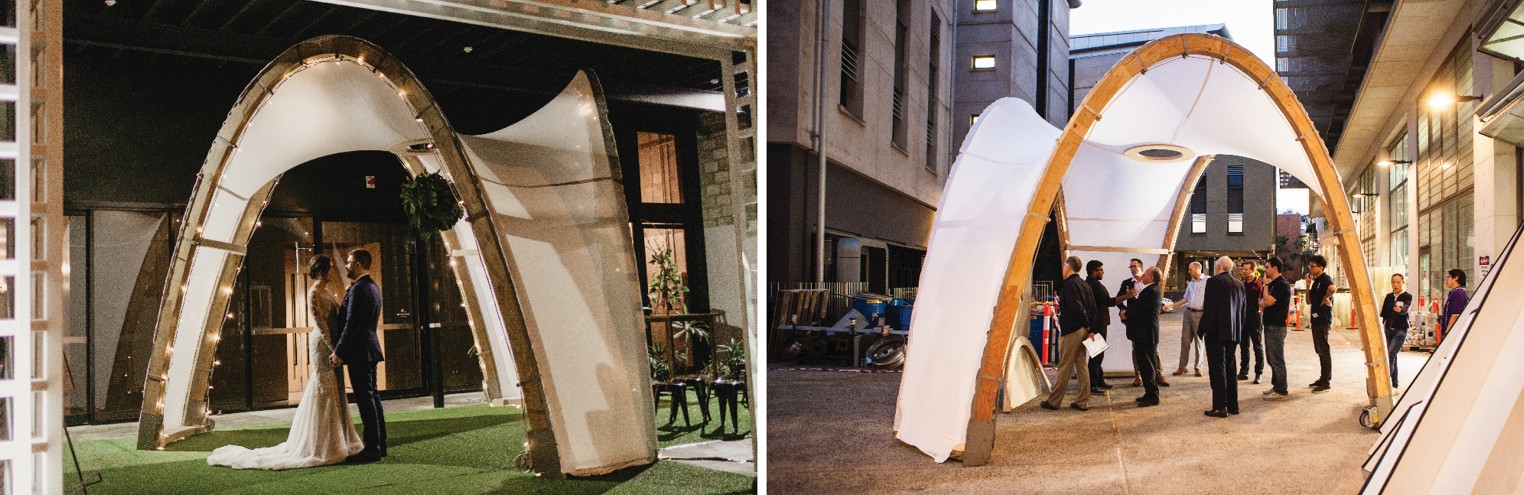
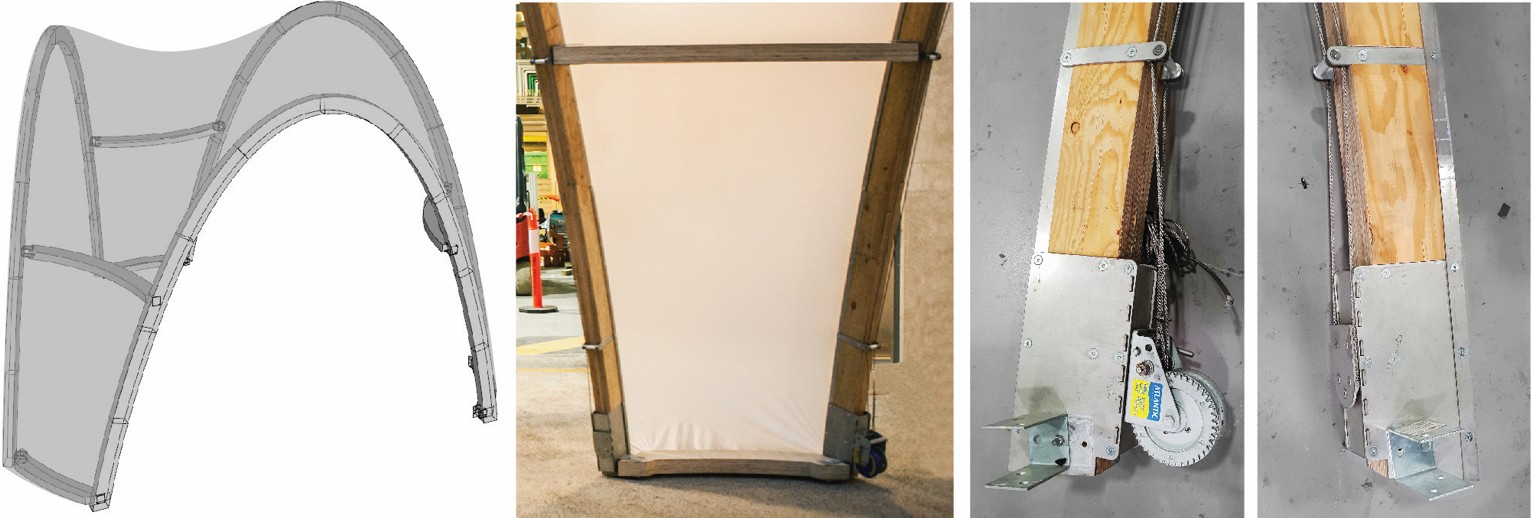
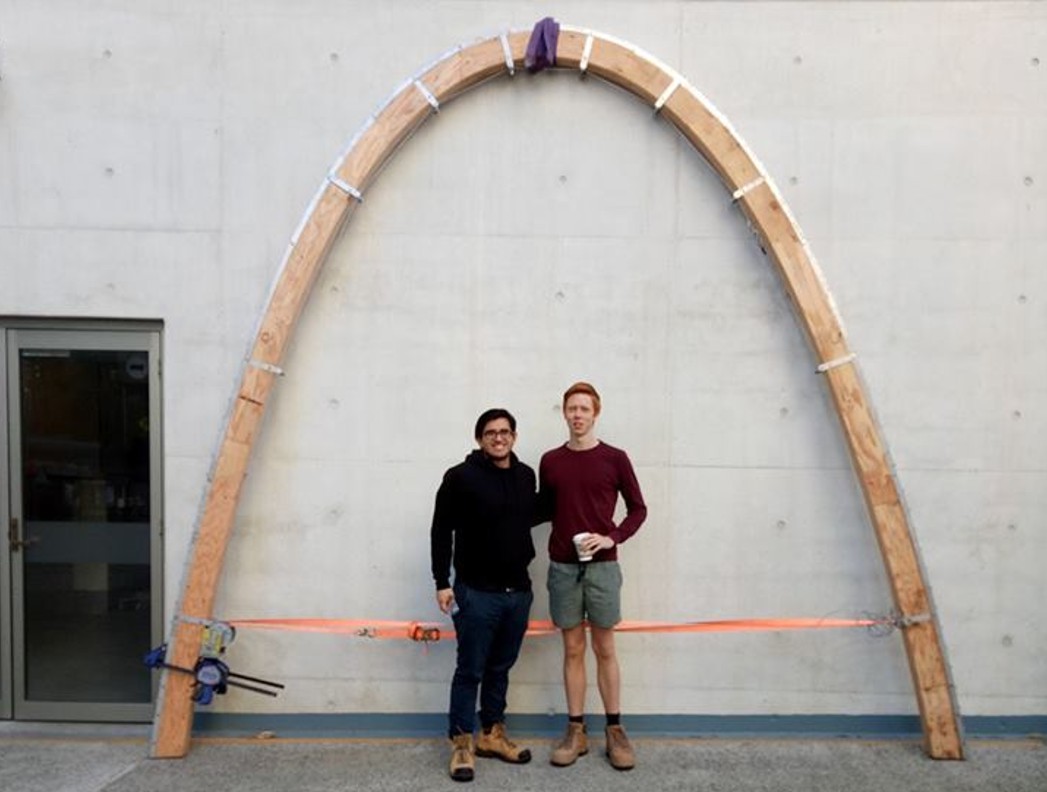
The mass timber stressed arch was developed as a deployable timber structure that transforms from flat to curved through rotational assembly and post-tensioning. Its computational design and digital fabrication used two techniques: a subdivision scheme for efficient manufacturing of arch modules, and a hybrid joint system that managed kinematic freedoms and fixities between modules. Experimental testing of a full-scale arch showed high load capacity and identified shearing of the pin connection between modules as the ultimate failure mode. Further information: DOI:10.20898/j.iass.2019.199.030.
Robotic Fabrication of FRP Formwork
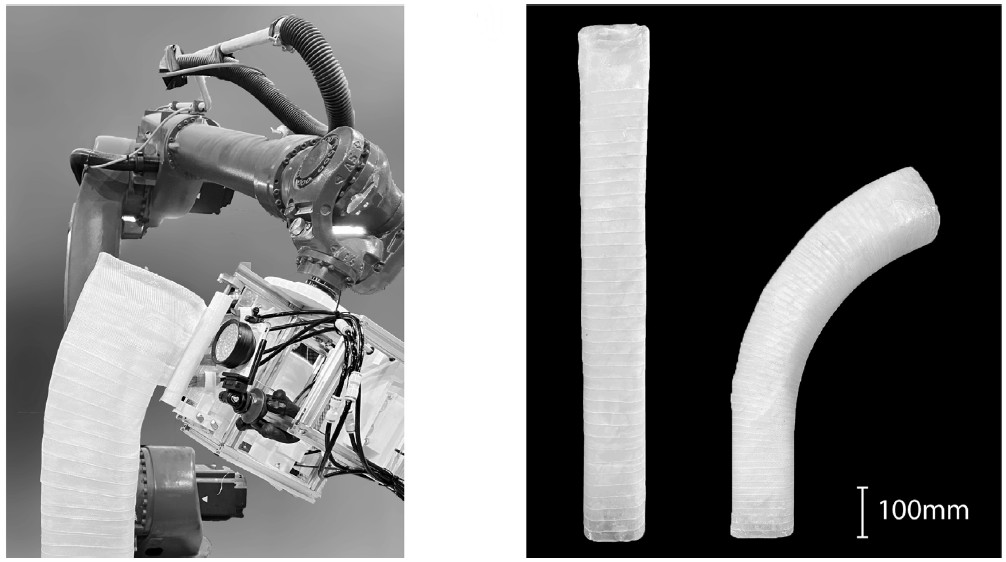
An automated additive lamination manufacturing (ALM) system was developed to produce large-scale fibre reinforced polymer (FRP) structural formwork without moulds, using a robotic arm end-effector that laid glass fibre tape with a UV-curable resin matrix. Compared with the earlier semi-automated system, the automated system produced parts of better geometric quality at faster build speeds, and further prototypes examined how layer height affected fabrication performance. Fabrication productivity was benchmarked against industry standards and other FRP additive manufacturing approaches. Further information: DOI:10.1016/j.autcon.2025.105978.
Prototypes and Exhibitions
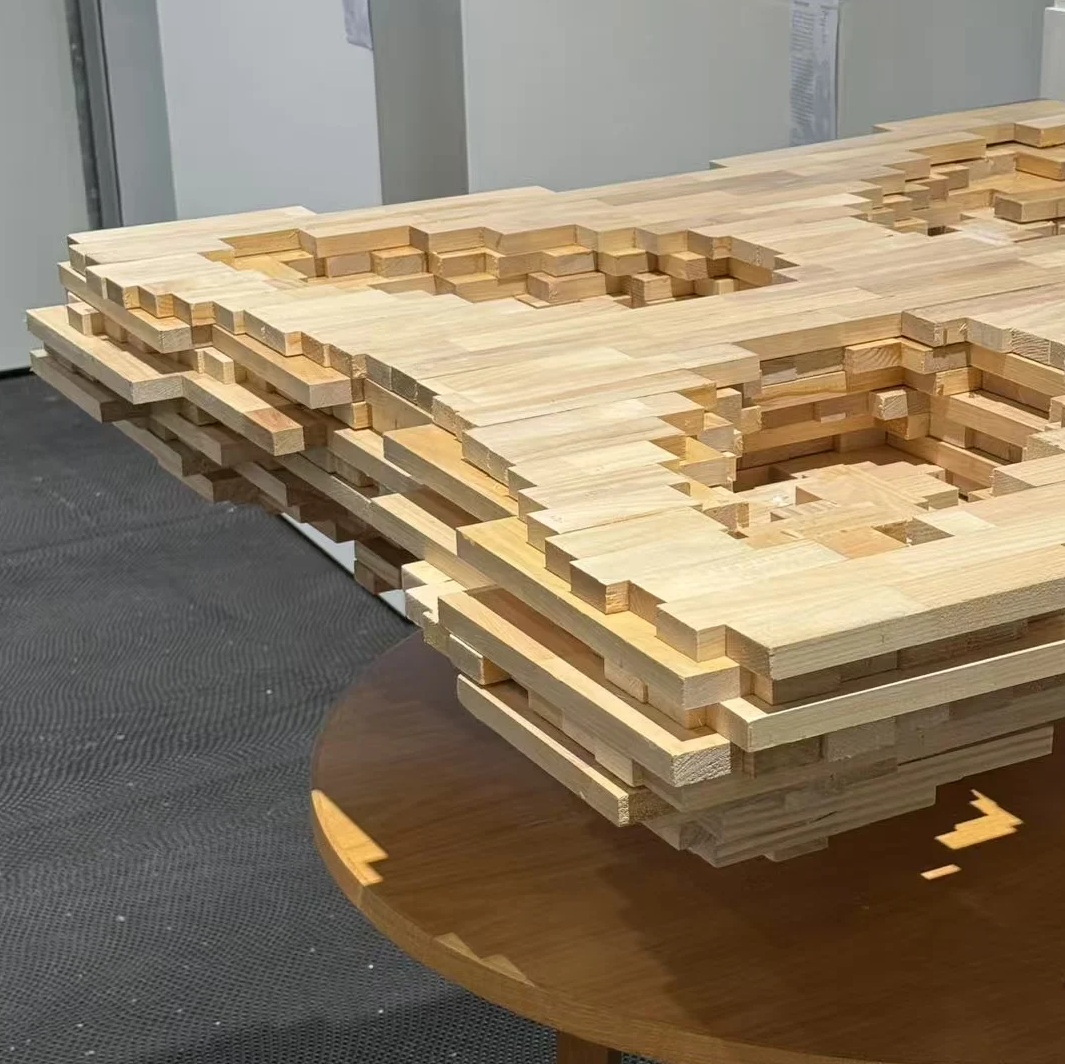 Research Prototypes 2025 - 2026
Digital design and fabrication for lightweight structures
 Plate House 2019-2022
Digital fabrication of plywood transitional shelters
 Externally Post-Tensioned Deployable Timber Structures
Future Timber Research Pavilion 2017-18
 Plate House 2017
Digital fabrication of FRP-timber transitional shelters
 Bending-Stabilised Structures
Future Timber Research Pavilion 2016
 Plate House 2013
Folded sandwich transitional shelters
Code and Software

Related Publications
Xin, Z.-Y., Zhu, G.-Q., Gattas, J. M., & Luo, D. (2025). Automated large-scale additive manufacturing of structural formwork with rapid fibre-reinforced polymer tape lamination. Automation in Construction, 171, 105978. https://doi.org/10.1016/j.autcon.2025.105978
Wu, L., Bao, D., Chen, B., Luo, D., & Gattas, J. M. (2025). Reimagining timber: An integrated approach of resource efficient fabrication process for topologically optimised cross-laminated timber slabs. In World conference on timber engineering 2025 (pp. 2695–2703). World Conference On Timber Engineering 2025. https://doi.org/10.52202/080513-0329
Baber, K., Chen, C., & Gattas, J. M. (2025). Laminated nodes for a round timber structure. In World conference on timber engineering 2025 (pp. 873–881). World Conference On Timber Engineering 2025. https://doi.org/10.52202/080513-0109
Feng, Y., Ren, H., Baber, K., Chen, C., Yuan, X., & Gattas, J. M. (2025). Inventory-constrained design method for whole tree use in branching canopy structures. In World conference on timber engineering 2025 (pp. 3976–3983). World Conference On Timber Engineering 2025. https://doi.org/10.52202/080513-0487
Chen, C., Baber, K., Gattas, J., Burry, M., & Nygaard, C. A. (2025). From wastewater to building: Harnessing digital fabrication for circular economy innovations. In Proceedings of the 30th conference on computer aided architectural design research in asia (CAADRIA) [volume 3] (Vol. 3, pp. 427–436). CAADRIA. https://doi.org/10.52842/conf.caadria.2025.3.427
Baber, K. R., Barton, A., Burry, J. R., Chen, C., Gattas, J. M., Koch, C., & Ren, H. (2023). Inventory-constrained design of a variable small diameter round timber structure. In Proceedings of IASS annual symposia (Vol. 2023, pp. 1–12). International Association for Shell; Spatial Structures (IASS).
Alqaryouti, Y., Fernando, D., & Gattas, J. M. (2021). Structural behaviour of folded timber sandwich structures. Thin-Walled Structures, 169, 108345. https://doi.org/10.1016/j.tws.2021.108345
Baber, K. R., Burry, J. R., Chen, C., Gattas, J. M., & Bukauskas, A. (2020). Inventory constrained design of a timber funicular structure. SN Applied Sciences, 2(9), 1–19. https://doi.org/10.1007/s42452-020-03314-9
Baber, K. R., BURRY, J. R., CHEN, C., GATTAS, J. M., & BUKAUSKAS, A. (2019). Inventory constrained funicular modelling. In Proceedings of the IASS annual symposium 2019 ’form and force’.
Plasencia Alava, K. B., McCann, L. K., Hodge, G., Baber, K., & Gattas, J. M. (2019). Computational design and experimental behaviour of deployable mass timber arches. Journal of the International Association for Shell and Spatial Structures, 60(1), 90–100. https://doi.org/10.20898/j.iass.2019.199.030
Al-Qaryouti, Y., Baber, K., & Gattas, J. M. (2019). Computational design and digital fabrication of folded timber sandwich structures. Automation in Construction, 102, 27–44. https://doi.org/10.1016/j.autcon.2019.01.008
Plasencia Alava, K. B., McCann, L., Baber, K., & Gattas, J. M. (2018). Reconfigurable assemblies of a deployable mass timber structure. In Proceedings of the IASS annual symposium 2018 ’creativity in structural design’.
Al-Qaryouti, Y., Gattas, J. M., Shi, R., & McCann, L. (2016). Digital fabrication strategies for timber thin-walled sections. In High performance and optimum design of structures and materials II (Vol. 166, p. 415). WIT Press. https://doi.org/10.2495/HPSM160391
Gattas, J. M., & You, Z. (2016). Design and digital fabrication of folded sandwich structures. Automation in Construction, 63, 79–87. https://doi.org/10.1016/j.autcon.2015.12.002