Deployable (Bending-Active) Structures
Part of the Origami-Inspired Design research theme.
Bending-active structures use the elastic bending of flat sheets or slender members to form curved geometry. Research in the Lab combines elastic bending with kirigami and self-shaping materials, so that flat sheets can be transformed into curved surfaces and deployable structures through simple actuation. Related work on deployment through folding is described under Deployable (Origami) Structures, and on curved folding under Curved-Crease Origami.
Bending-Active Kirigami
Bending-active kirigami was introduced as a family of pop-up kirigami patterns that transform flat sheets into double-curved surfaces through a simple 1-DOF actuation mechanism. The design technique combined the ‘elastica’ solution for elastic deformation of slender rods with kirigami pop-up mechanics, giving a rapid, intuitive method for creating formed surfaces and their kirigami patterns. The concept was extended to patterns based on different elastica solutions and pop-up mechanisms, and applied to a deployable structure, with measurements from a physical prototype validating the design method. Further information: DOI: 10.1016/j.ijsolstr.2022.111864.
Self-Shaping Curved Surfaces
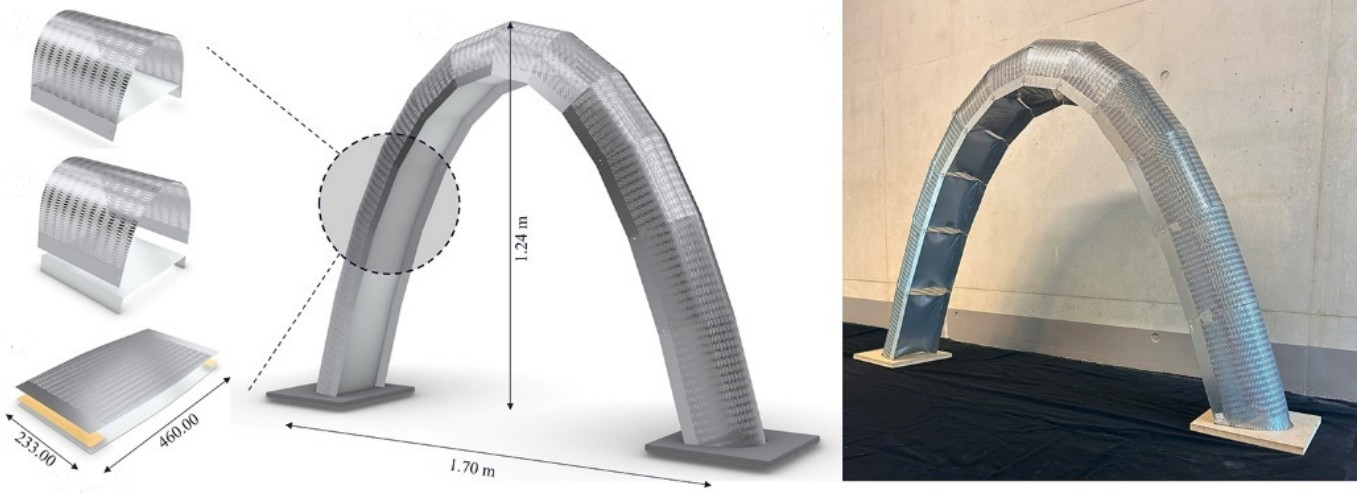
Self-shaping systems form 3D geometry from the material-driven transformation of flat sheets, but have mostly been developed at small scales. A self-shaping composite was developed for larger curved surfaces suited to spatial structures, combining a perforated plate passive layer with a heat-shrinkable active layer. 3D scanning and parametric curvature analysis showed that the resulting surfaces were cylindrical, with approximately uniform curvature that was controlled mainly by the perforation bridge and strap lengths. Further information: DOI: 10.1007/s44223-024-00059-y. The approach has since been applied to self-shaping steel curved surfaces with lamina emergent torsion arrays (DOI: 10.52842/conf.caadria.2025.2.439).

Related Publications
Bahremandi-Tolou, M., Gattas, J. M., & Luo, D. (2025). Design and fabrication of self-shaping steel curved surfaces with lamina emergent torsion arrays. In Proceedings of the 30th conference on computer aided architectural design research in asia (CAADRIA) [volume 2] (Vol. 2, pp. 439–448). CAADRIA. https://doi.org/10.52842/conf.caadria.2025.2.439
Bahremandi-Tolou, M., Wang, C., Gattas, J. M., & Luo, D. (2024). Curved surface form-finding with self-shaping perforated plates. Architectural Intelligence, 3(1), 1–16. https://doi.org/10.1007/s44223-024-00059-y
Lee, T.-U., Gattas, J. M., & Xie, Y. M. (2022). Bending-active kirigami. International Journal of Solids and Structures, 254, 111864. https://doi.org/10.1016/j.ijsolstr.2022.111864
Lee, T., & Gattas, J. (2016). Experimental analysis of a reverse elastica pop-up geometry. In 8th international conference on fibre-reinforced polymer (FRP) composites in civil engineering (CICE 2016). Retrieved from https://espace.library.uq.edu.au/view/UQ:500012