Curved-Crease Origami

Part of the Origami-Inspired Design research theme.
Curved-crease origami differs from prismatic, or straight-crease, origami in that the surface of the pattern bends during folding. Curved-crease patterns are developable but have regions of non-zero principal curvature. This combination of properties has led to their use in a range of engineering applications, and their visual qualities have made them popular in fine art, industrial design, and architecture. Related work on curved-crease deployable tubes, and on elastically bent and self-shaping surfaces, is described under Deployable (Origami) Structures and Deployable (Bending-Active) Structures, respectively.
Rigid-Foldable Curved-Crease Approximations
To reduce the difficulty in parameterising and modelling the pattern geometry, the curved-crease surface was approximated as a planar quadrangle (PQ) mesh, using Miura-type patterns as a ‘base’ geometry from which to build the approximation. The generated curved-crease pattern corresponded to a piecewise assembly of self-similar straight-crease patterns, and so could be used to simulate a rigid single-DOF folding motion. Further information: DOI: 10.1115/1.4028532.


Elastica Curved-Crease Origami
An analytical geometric construction method for elastica curved-crease origami combined a 1D elastica solution for large elastic bending deformation with a straight-crease origami projection and reflection process. This avoided the need for surface discretisation, and concisely and accurately captured the principal surface curvature and developability characteristics of elastically bent curved-crease origami. Further information: DOI: 10.1016/j.ijsolstr.2017.11.029.


Composite Fabrication Techniques for Curved-Crease Folding
A cured-in-place manufacturing process was developed to fold curved-crease sections from fibre-reinforced polymer (FRP) composite and FRP-timber hybrid sheets. The process used a differential curing time between two types of resin impregnated in a glass-fibre sheet: a 24-hour slow-cure resin on crease lines and a 3-hour fast-cure resin on panel regions. The 2D sheet was folded into a 3D section between the fast-cure and slow-cure periods, when panel regions were rigid and hinge regions remained flexible. Further information: Paper 1, Paper 2.


Compliant Curved-Crease Metamaterials
A compliant curved-crease metamaterial was developed with ‘elastica’ non-zero principal surface curvature, with construction parameters shown to affect the shape, duration, and magnitude of its non-linear force–displacement response. A concise analytical curved-crease bending translation (CCBT) method predicted these responses quickly, enabling the design of metamaterials with programmable compliant force–displacement responses. Further information: DOI: 10.1016/j.matdes.2021.109859.

Curved-Crease Face Shields
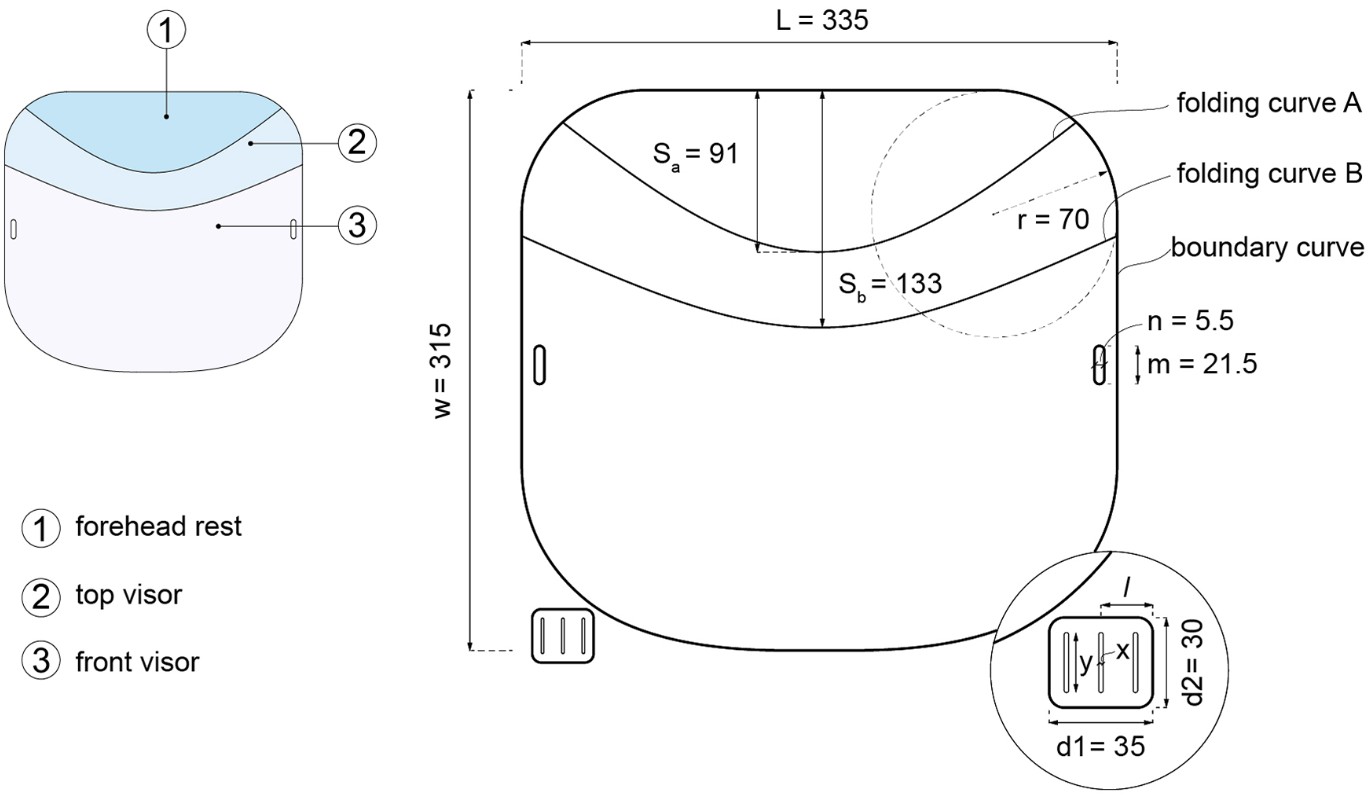
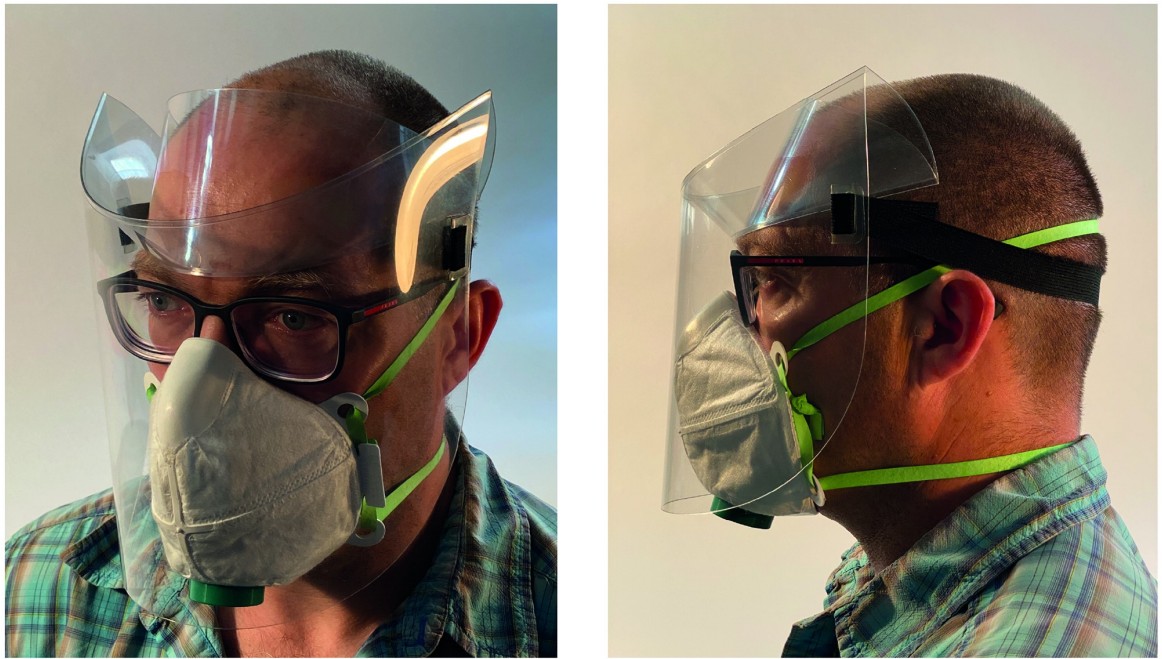
During the COVID-19 pandemic, curved-crease origami was used to turn flat sheets of flexible plastic into face shields for infection control. The design could be produced by methods ranging from manual techniques to high-volume die-cutting and creasing, so that it could be made with whatever materials, manufacturing capability, and labour were available locally. A physical-digital parametric design method allowed others to adapt the design to different ergonomic and protection requirements. Further information: DOI: 10.1371/journal.pone.0245737. See also the Happy Shield project.
Prototypes and Exhibitions
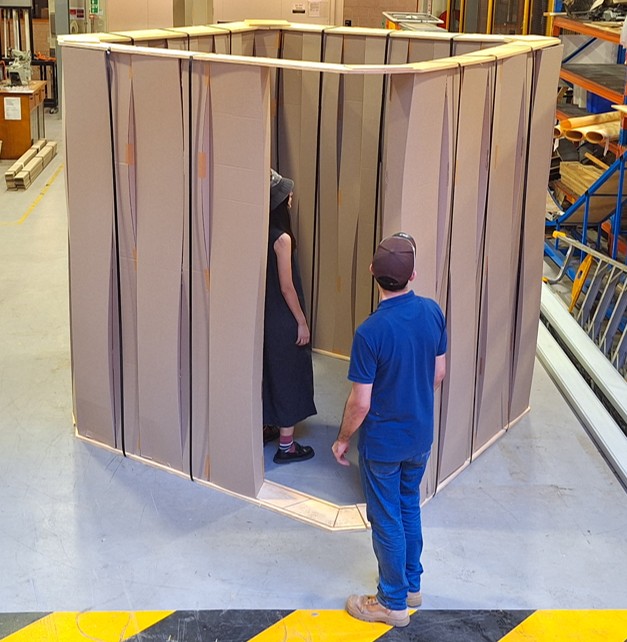 Origami Block Prototypes 2023 - 2025
Modular curved-crease origami with the University of Tokyo
 Happy Shield
Curved Crease Origami Face Shield
 Research Prototypes 2014 - 2015
Folding approaches for deployable shelters and infrastructure
Code and Software
 Rigid Origami Toolbox
A Matlab toolbox to support research and design of origami-inspired structures
Related Publications
Lee, M., Gattas, J. M., & Tachi, T. (2026). Multistable curved-crease origami blocks for reconfigurable modular building system. In Proceedings of IASS annual symposia 2025, méxico city, méxico, 27-31 october 2025. International Association for Shell; Spatial Structures (IASS).
Lee, M., Abu-Saleem, M., Tachi, T., & Gattas, J. M. (2026). A lightweight building construction system using curved-crease origami blocks. In Origami8, volume i (pp. 253–264). Springer Nature Singapore. https://doi.org/10.1007/978-981-96-8664-3_18
Zhang, Q., Gattas, J. M., & Feng, J. (2025). Effect of crease-weakening schemes on the structural performance of lightweight foldable columns based on the pillow box pattern. Applied Sciences, 15(19), 10756. https://doi.org/10.3390/app151910756
Lee, T.-U., Chen, Y., Heitzmann, M. T., & Gattas, J. M. (2021). Compliant curved-crease origami-inspired metamaterials with a programmable force-displacement response. Materials & Design, 109859. https://doi.org/10.1016/j.matdes.2021.109859
Bukauskas, A., Koronaki, A., Lee, T.-U., Ott, D., Al Asali, M. W., Jalia, A., et al.others. (2021). Curved-crease origami face shields for infection control. Plos one, 16(2), e0245737. https://doi.org/10.1371/journal.pone.0245737
Lee, T.-U., You, Z., & Gattas, J. M. (2018). Elastica surface generation of curved-crease origami. International Journal of Solids and Structures, 136-137, 13–27. https://doi.org/10.1016/j.ijsolstr.2017.11.029
Lee, T., & Gattas, J. (2016). Folded fabrication of composite curved-crease components. In 8th international conference on fibre-reinforced polymer (FRP) composites in civil engineering (CICE 2016). Retrieved from https://espace.library.uq.edu.au/view/UQ:500008
Gattas, J. M., & You, Z. (2014). Miura-base rigid origami: Parametrizations of curved-crease geometries. Journal of Mechanical Design, 136(12), 121404. https://doi.org/https://doi.org/10.1115/1.4028532