FRP-Timber Composite Panels
Part of the Timber & Bio-Based Construction research theme.
Hybrid panels combine timber with concrete or fibre reinforced polymer (FRP) to increase the strength, stiffness, and span of timber floor systems. Research in the Lab develops hybrid timber-concrete floor panels with digitally fabricated timber cores, and FRP reinforcement for laminated timber products such as glulam and cross-laminated timber (CLT). Related work on thin-walled members is described under FRP-Timber Composite Sections.
Hybrid Timber-Concrete Floor Panel Systems
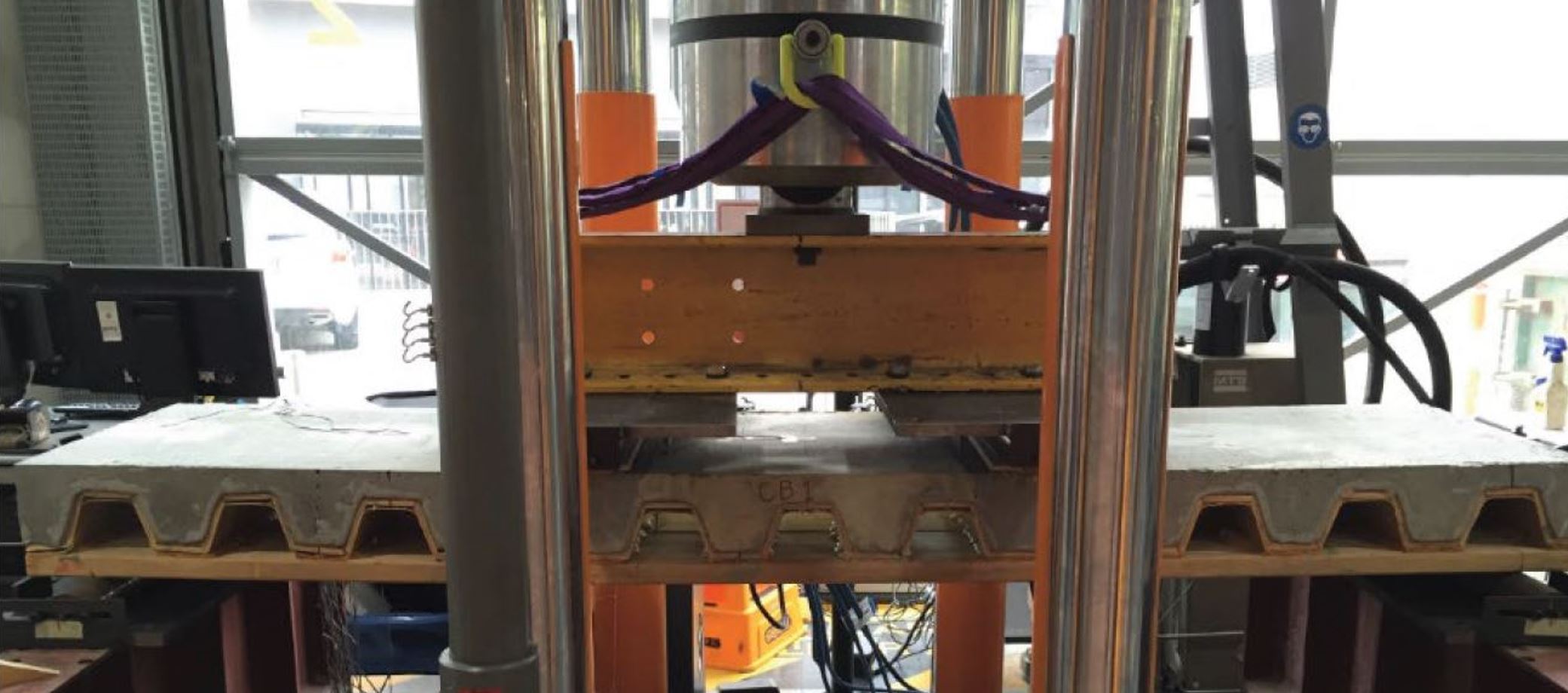
Hybrid timber-concrete corrugated (HTCC) floor panel systems extended conventional hybrid timber-concrete (HTC) systems. The first system placed a corrugated core between the timber and concrete layers, to increase weight-specific flexural capacity by reducing concrete volume without reducing strength. Tests of flexural capacity, failure modes, core geometry, shear force transfer, and composite action found that cores with a longitudinal orientation achieved 73% of the ultimate moment capacity and 85% of the service-load stiffness of an idealised fully composite HTC section. Further information: DOI:10.1016/j.engstruct.2019.109832.
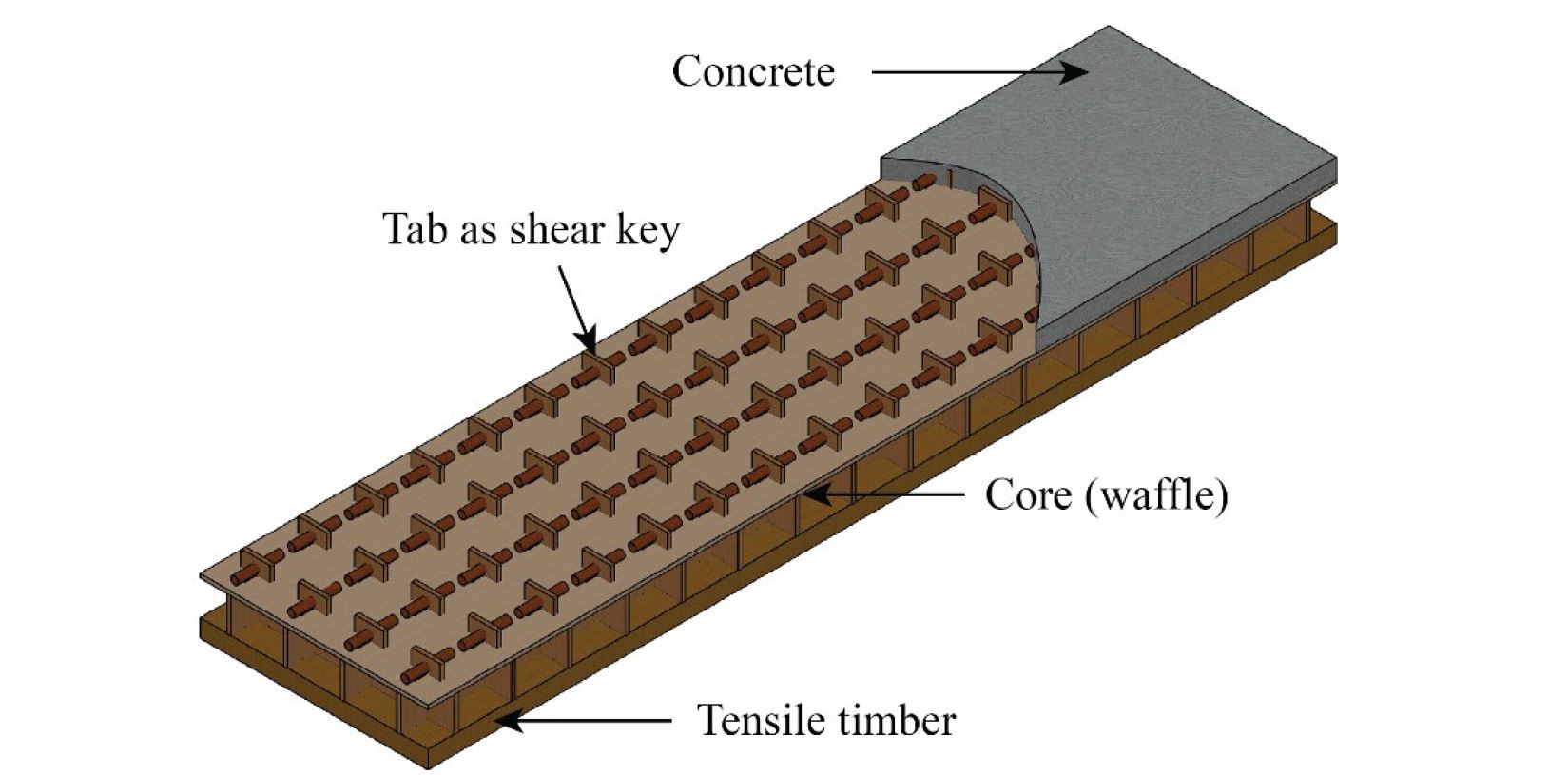
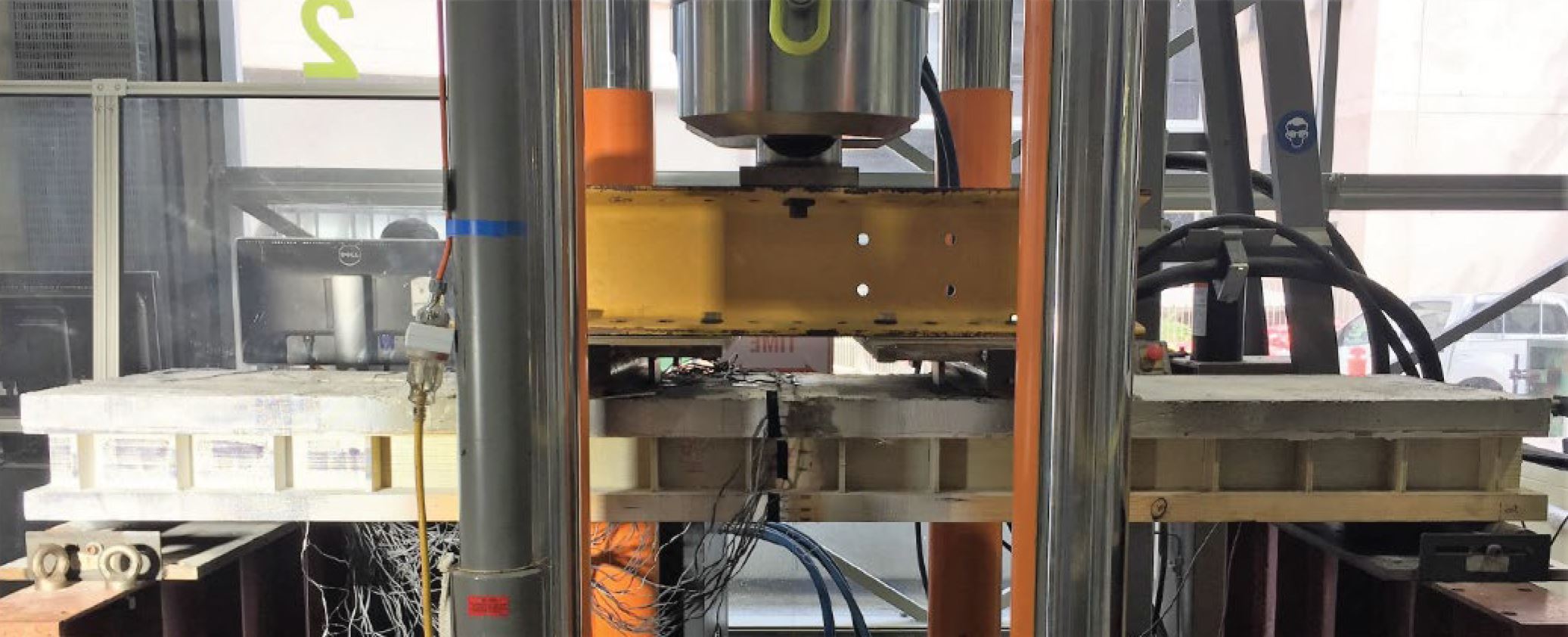
A second HTC system used a waffle-shaped FRP-timber core. The core components were made with digital fabrication techniques and computer numerical control (CNC) machines, which made them easy to fabricate, accurate, and quick to manufacture. Panel tests showed high flexural capacity and high ductility before ultimate failure, and a higher weight-specific moment capacity than equivalent reinforced concrete and HTC panels. Further information: DOI:10.1016/j.conbuildmat.2019.08.048. A nonlinear beam-spring-beam element was also developed to model the flexural behaviour of timber-concrete sandwich panels with a cellular core (DOI:10.1016/j.engstruct.2021.112785).

FRP-Reinforced Laminated Timber Products
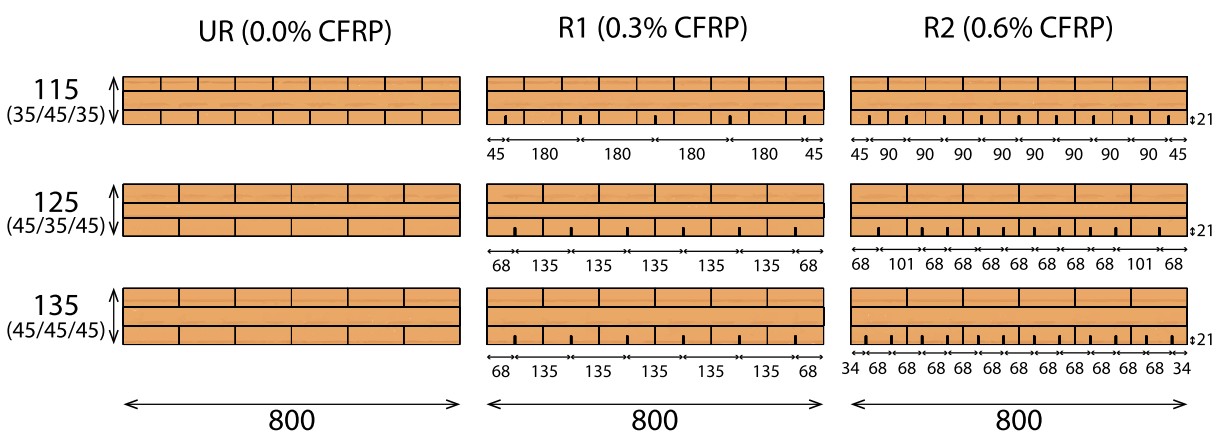
Carbon fibre reinforced polymer (CFRP) reinforcement has also been applied to CLT panels. Bending tests on 27 three-ply CLT panels, with reinforcement ratios up to 0.6% and thicknesses from 115 mm to 135 mm, showed increases of up to 37% in strength and 27% in stiffness. Reinforcement also changed the failure mode from brittle tensile fracture to pseudo-ductile tensile and ductile compressive failure, and an analytical cross-sectional model predicted the strength, stiffness, and failure mode of reinforced and unreinforced panels. Further information: DOI:10.1016/j.engstruct.2025.120653.
For floors, where vibration often governs the span of mass timber, CFRP reinforcement of three-ply CLT panels at ratios below 0.67% raised natural frequencies by 6% to 11% and effective flexural stiffness by 15% to 22%. Within current vibration design limits for timber floors, this corresponded to maximum spans around 4% to 6% longer. Further information: DOI:10.1016/j.conbuildmat.2024.137075. Related work developed an interactive parametric design and optimisation tool for FRP-reinforced mass timber buildings (DOI:10.52202/080513-0289)
Downscale Testing of FRP-Reinforced Timber Products
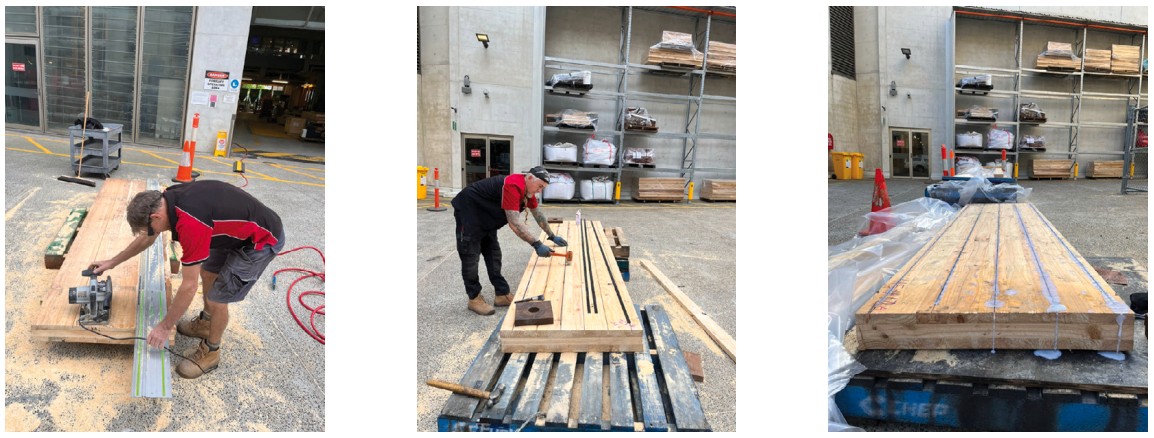
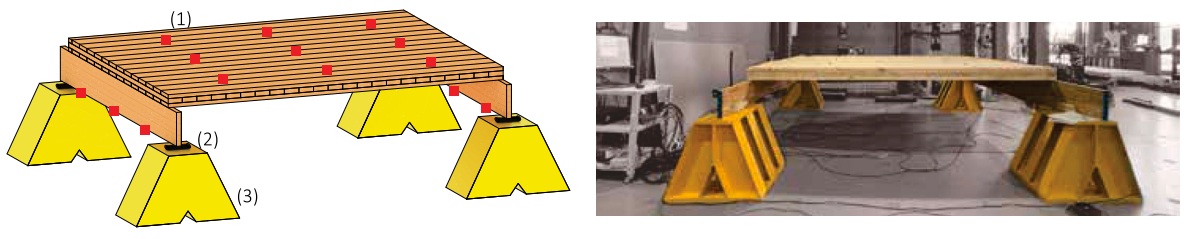
Small-scale testing was assessed as an alternative to full-scale tests for timber and timber-hybrid systems, particularly for serviceability measures such as natural frequency and stiffness in long-span systems. The ‘size effect’ was examined in glulam and carbon fibre reinforced glulam beams, by comparing the dynamic and static performance of full-scale and half-scale beams. Scale had a minor effect on serviceability but a clear effect on strength, with full-scale beams showing lower strength. Tension-only reinforcement in hybrid beams appeared to reduce this size effect. Further information: DOI:10.1016/j.conbuildmat.2023.130563.
Related Publications
Bravo, T. P., Beltrán, J. F., Maluk, C., & Gattas, J. M. (2025). Enhancement of the out-of-plane bending performance of CLT panels using CFRP reinforcement. Engineering Structures, 340, 120653. https://doi.org/10.1016/j.engstruct.2025.120653
Bravo, T., Mills, H., Maluk, C., & Gattas, J. M. (2025). Interactive parametric structural design and optimisation tool for design of FRP-reinforced mass timber buildings. In World conference on timber engineering 2025 (pp. 2374–2380). World Conference On Timber Engineering 2025. https://doi.org/10.52202/080513-0289
Bravo, T. P., Gattas, J. M., Bravo, F., Astroza, R., & Maluk, C. (2024). Experimental assessment of modal properties of hybrid CFRP-timber panels. Construction and Building Materials, 438, 137075. https://doi.org/10.1016/j.conbuildmat.2024.137075
Tetlak, T. B., Gattas, J. M., & Maluk, C. (2023). Experimental study on the effects of scale on the static and dynamic behaviour of glulam and hybrid-glulam beams. Construction and Building Materials, 369, 130563. https://doi.org/10.1016/j.conbuildmat.2023.130563
Bravo Tetlak, T., Gattas, J. M., & Maluk, C. (2023). Scaling study on viscous damping for glulam and hybrid glulam-FRP beams. In. World Conference on Timber Engineering (WCTE 2023). https://doi.org/10.52202/069179-0007
Ya, O., Fernando, D., Sriharan, J., Gattas, J. M., & Zhang, S. (2021). A nonlinear beam-spring-beam element for modelling the flexural behaviour of a timber-concrete sandwich panel with a cellular core. Engineering Structures, 244, 112785. https://doi.org/https://doi.org/10.1016/j.engstruct.2021.112785
Ou, Y., Gattas, J. M., Fernando, D., & Torero, J. L. (2019). Experimental investigation of a timber-concrete floor panel system with a hybrid glass fibre reinforced polymer-timber corrugated core. Engineering Structures, 109832. https://doi.org/10.1016/j.engstruct.2019.109832
Ou, Y., Fernando, D., & Gattas, J. M. (2019). Experimental investigation of a novel concrete-timber floor panel system with digitally fabricated FRP-timber hollow core component. Construction and Building Materials, 227, 116667. https://doi.org/10.1016/j.conbuildmat.2019.08.048
Ou, Y., Fernando, D., & Gattas, J. M. (2017). Novel hybrid FRP-timber-concrete floor panel system. In APFIS2017-6th asia-pacific conference on FRP in structures, singapore (pp. 1–7). Retrieved from https://www.research.ed.ac.uk/en/publications/novel-hybrid-frp-timber-concrete-floor-panel-system