Resource-Adaptive Design
Part of the Timber & Bio-Based Construction research theme.
Timber is a renewable building material, and every harvest yields timber of varying size and quality. Because of this natural variability, conventional grading and design practice cannot make full use of the resource in structural building products. Resource-adaptive design adapts structures to the timber that is actually available, so that more of each harvest can be used in buildings. Research in the Lab develops design methods, connections, and data tools that turn this timber into structural components, and that track how timber moves from forest to building.
Related work on timber defect scanning is described in Scanning and Sensing, and on design-to-fabrication methods for timber construction in Digital Fabrication.
Inventory-Constrained Design
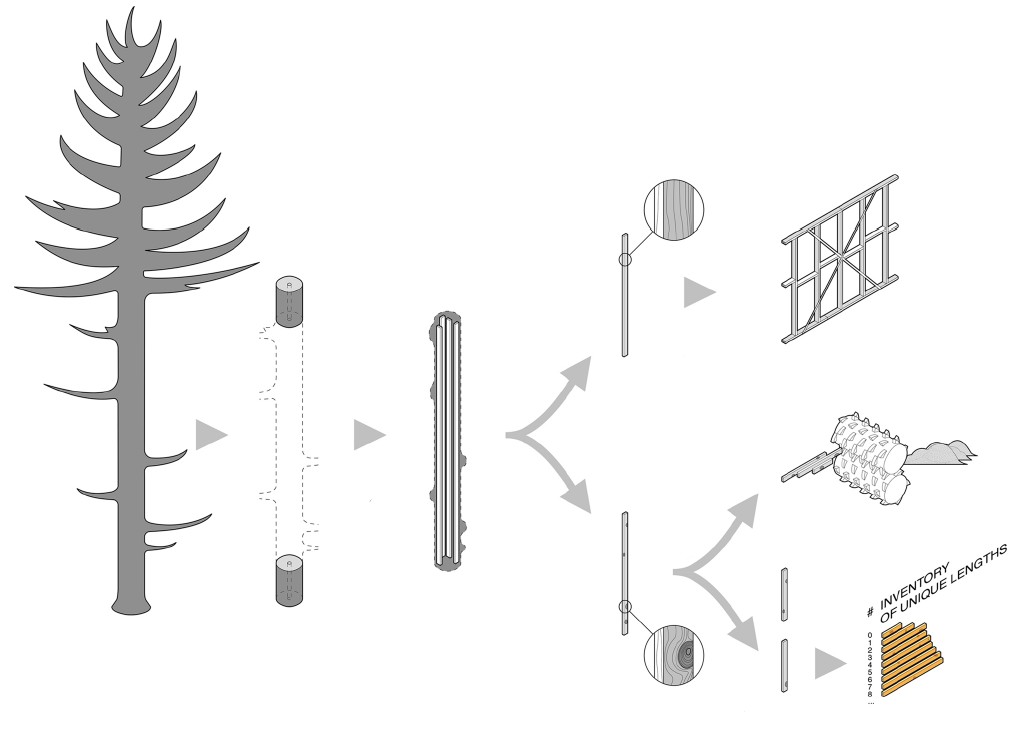
Inventory-constrained design starts from a fixed inventory of available members and finds a structure that uses them, rather than specifying members first and sourcing them afterwards. An early application combined funicular form finding with an inventory of short timber members, created by removing defects from sawn timber out-of-grade sawn timber, to recover up to 50% of the rejected timber as usable members. In the funicular geometry, the members carried only axial forces, which allowed simple timber connections. Further information: DOI:10.1007/s42452-020-03314-9.
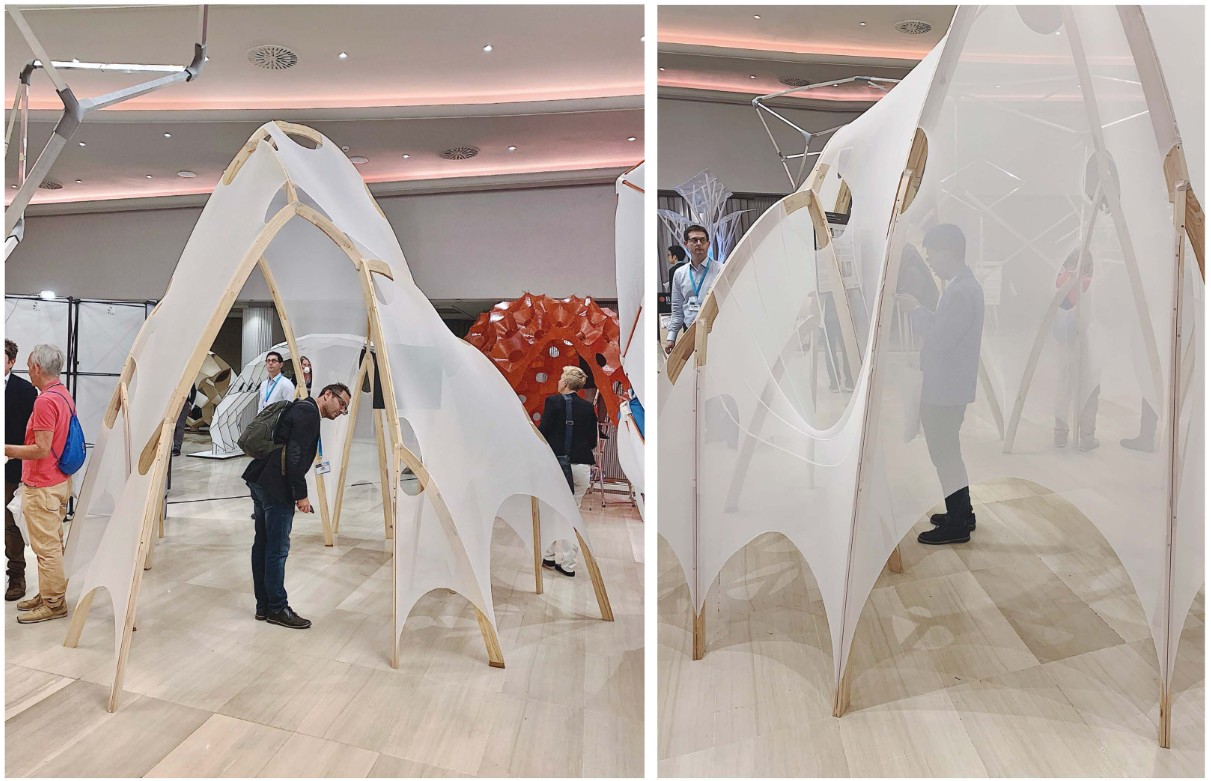
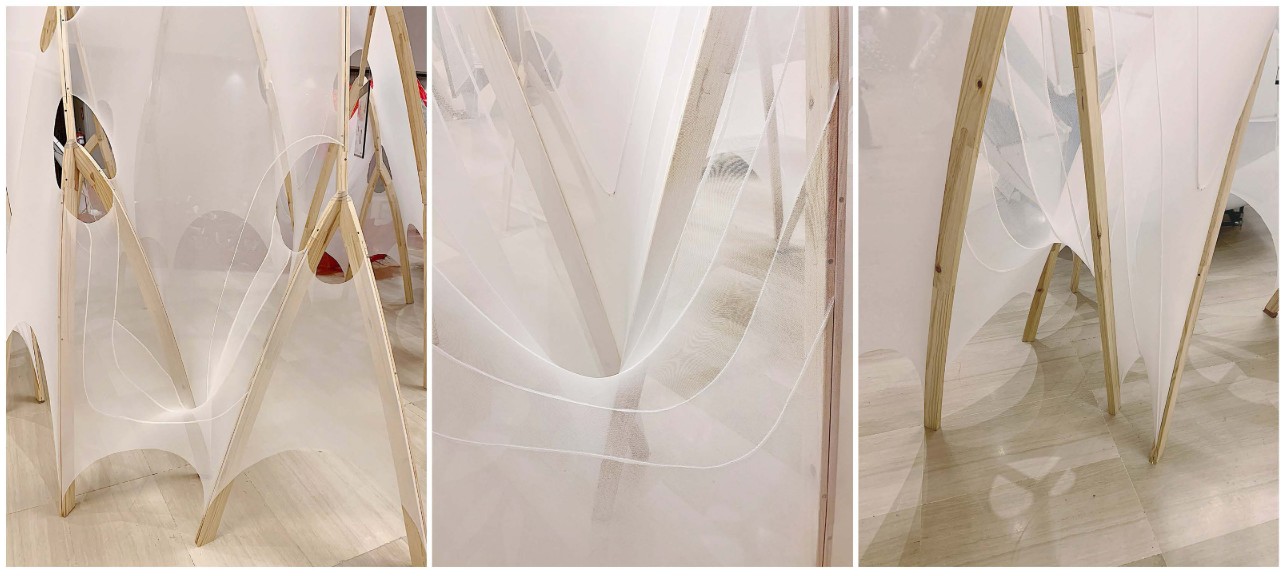
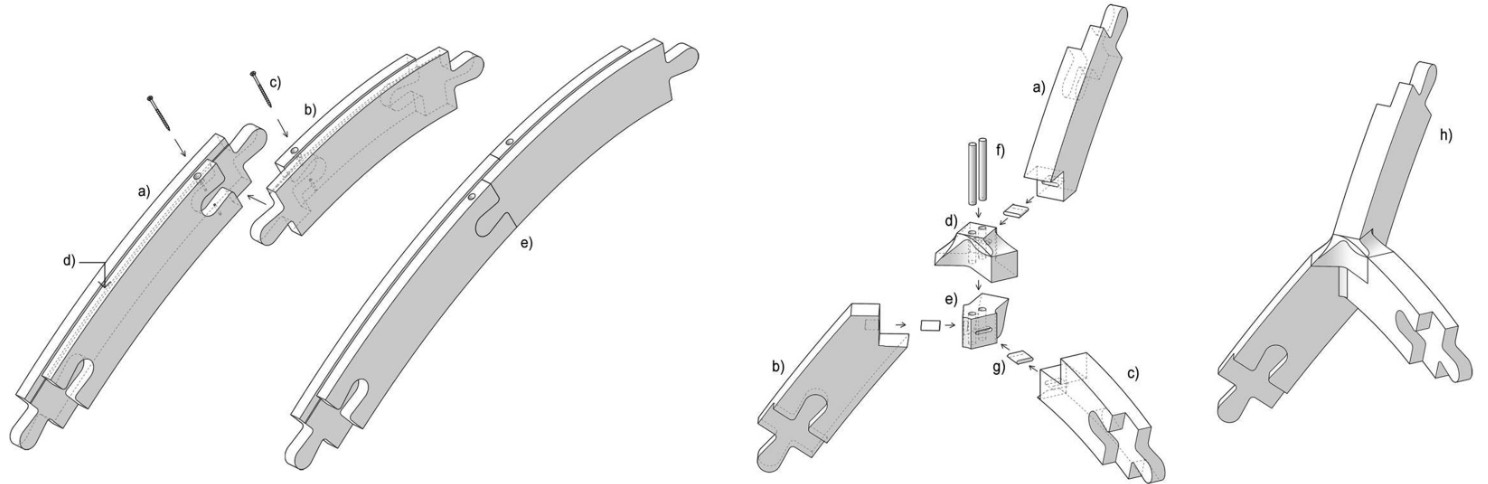
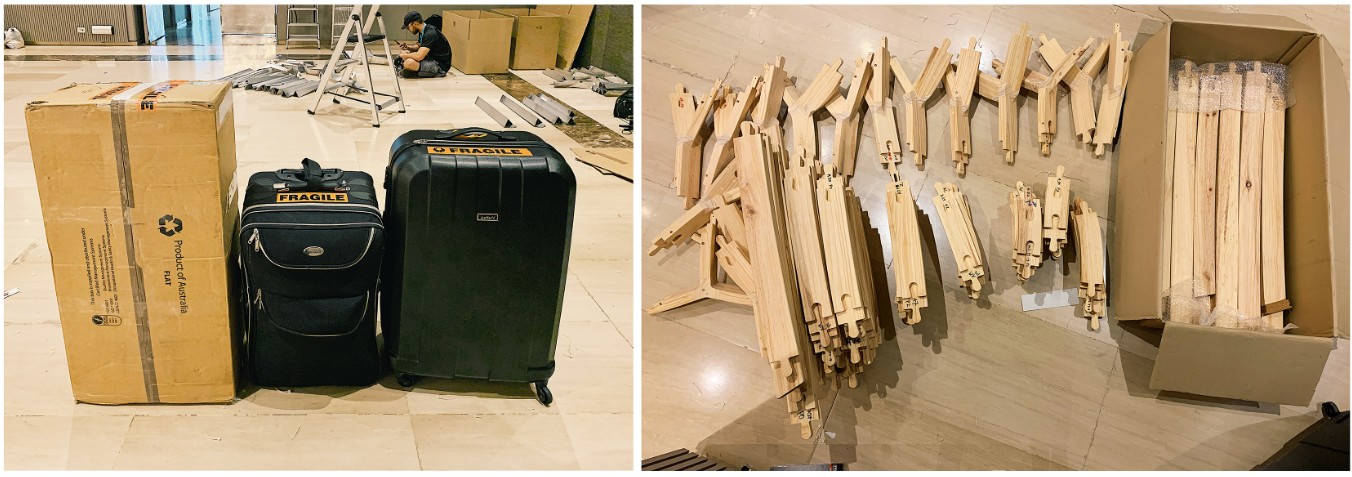
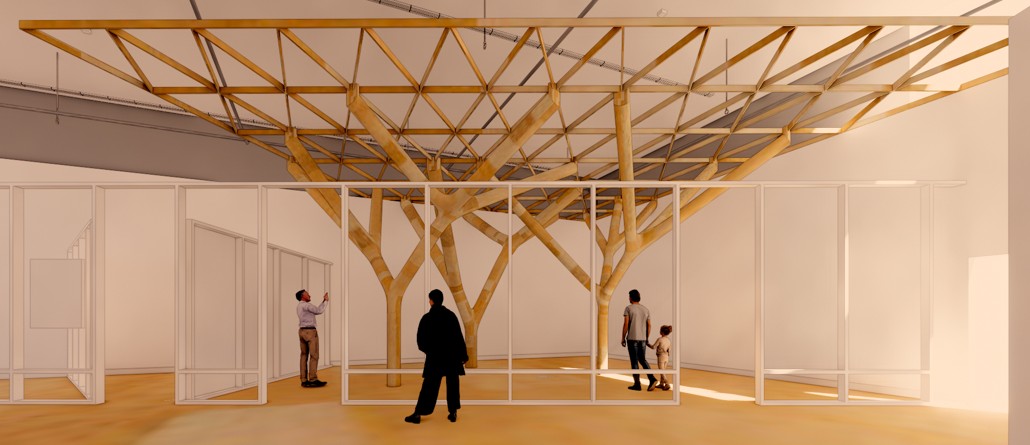
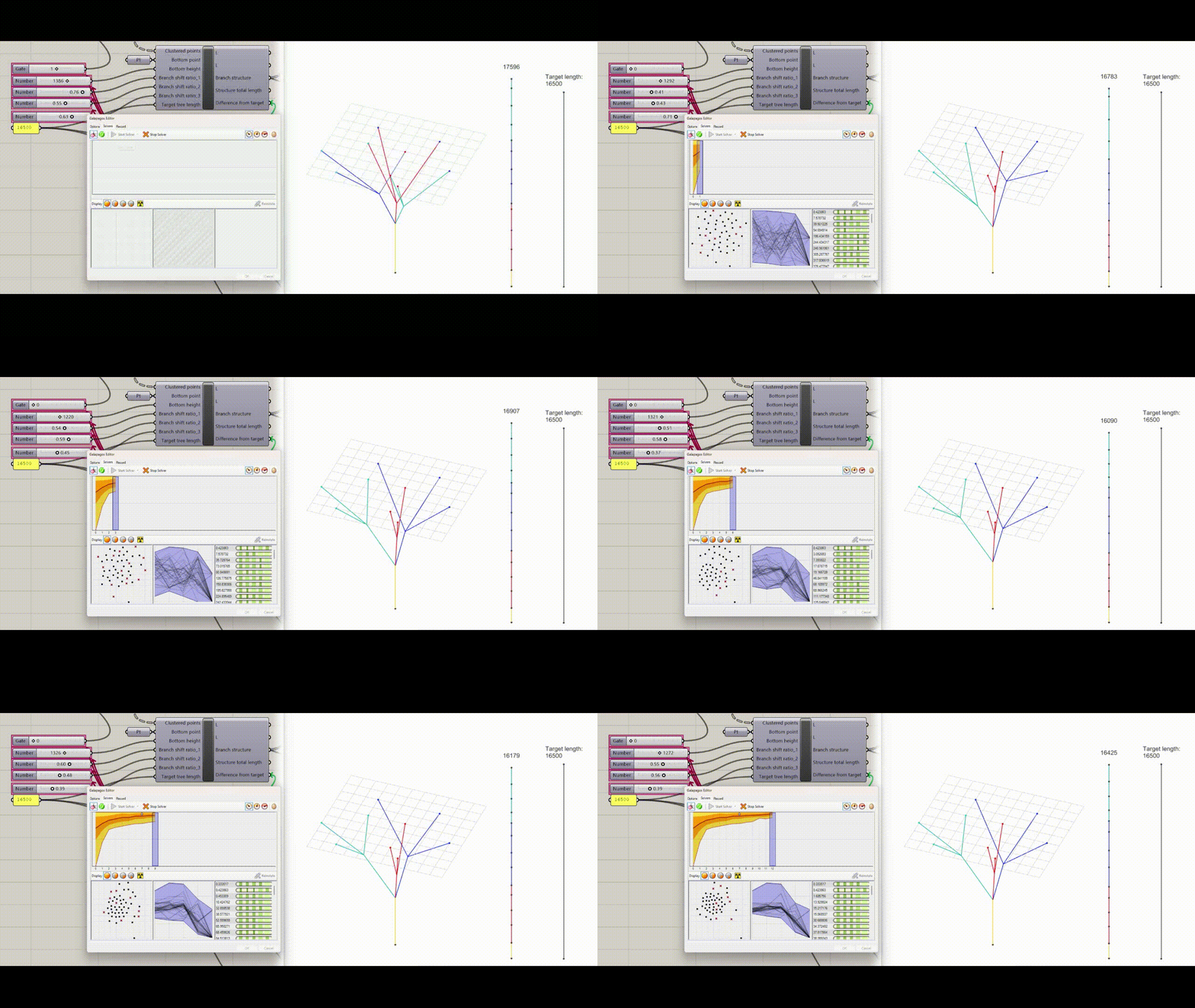
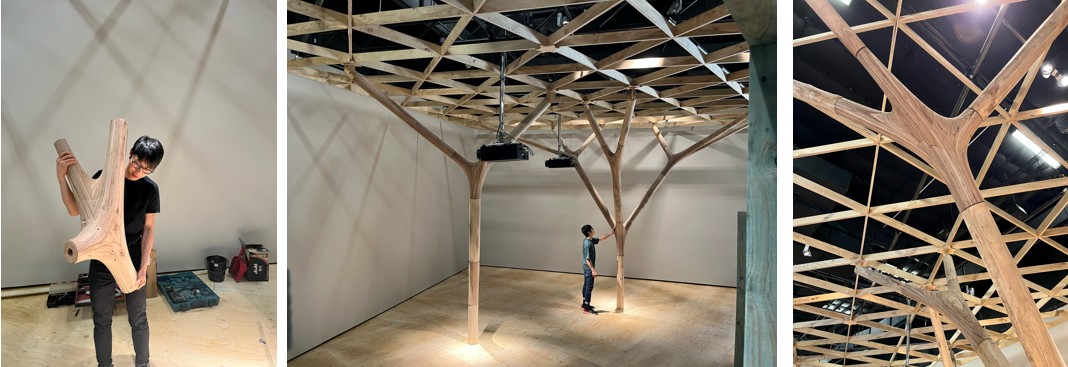
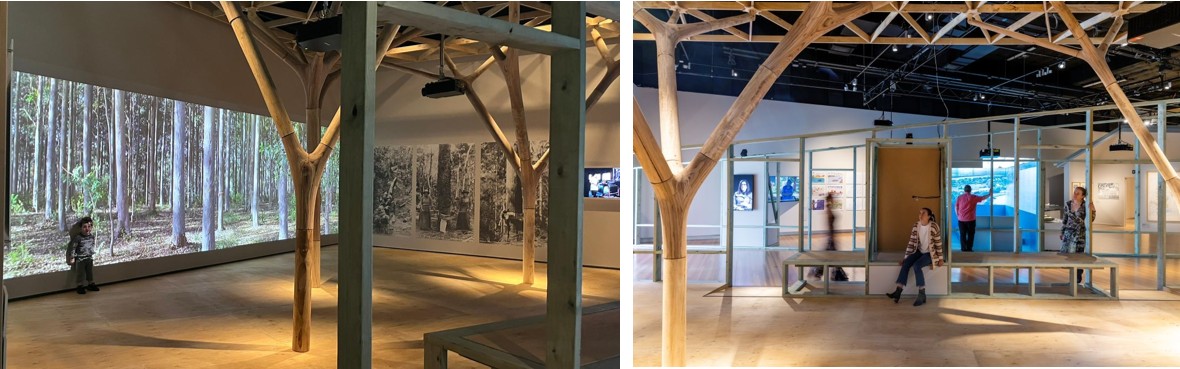
The method has since been extended to minimally processed round logs from plantation thinnings, which are low in value because of their small diameter and taper. A branched column was optimised to place each log according to its length and taper, and the digital fabrication of the resulting structure, from timber grown with treated wastewater, was developed as part of a circular economy. Further information: Proceedings of the IASS Annual Symposium 2023 and DOI:10.52842/conf.caadria.2025.3.427. Related work developed laminated nodes for round timber structures (DOI:10.52202/080513-0109), whole-tree use in branching canopy structures (DOI:10.52202/080513-0487), and modular membrane shade structures from plantation thinnings (DOI:10.1007/978-981-95-0090-1_24).
Out-of-Grade Timber
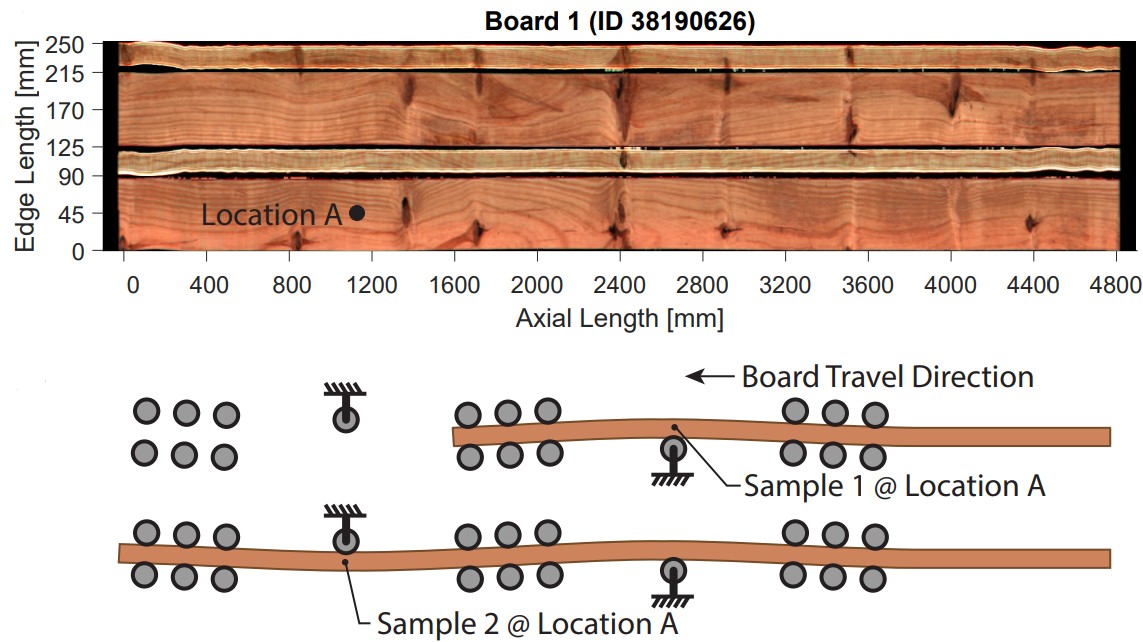
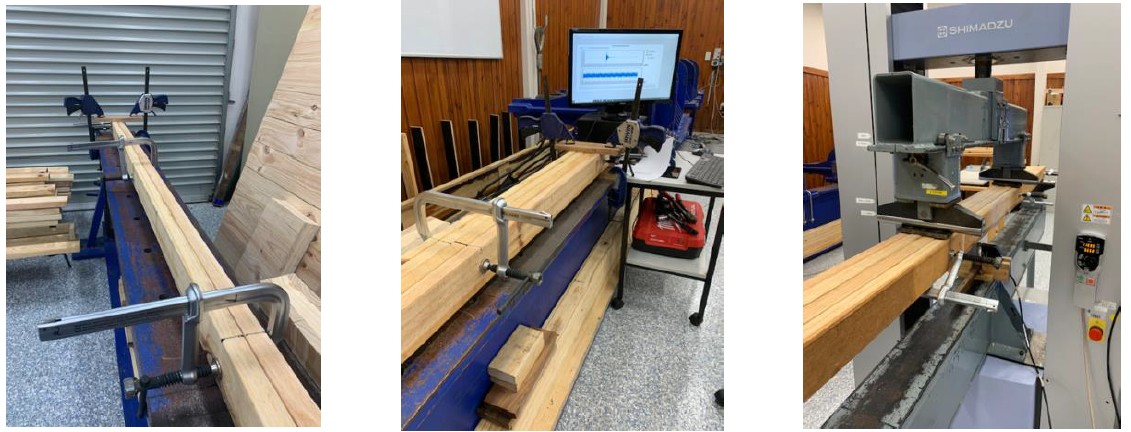
A large proportion of sawn plantation softwood boards fail to reach a structural grade because of stiffness, strength, or utility-limiting features. Controlled lamination was used to turn these out-of-grade boards into structurally-usable laminated products. Numerical and experimental comparisons of board assignment heuristics showed that controlling where each board was placed produced laminated products with very low stiffness variability, even when only two boards were laminated together. Further information: DOI:10.1080/14488353.2024.2403049.
Reclaimed Timber
Reclaimed timber is difficult to reuse in structures because its geometry is irregular and its material properties are mixed. A computational framework was developed to design timber-framed modular buildings from a mixed stock of reclaimed material, combining set-based stock allocation with integer linear programming optimisation in which cutting and jointing patterns were decision variables. Members could be cut and jointed into shorter, longer, or laminated members, and stock was allocated across the structural subsystems of each building. Two case studies demonstrated the framework, including the design of multiple modular houses from nearly two kilometres of recycled timber. A globally optimal solution for six houses was found in under 1.5 seconds, using 760 parts with 77.6% stock utilisation and 83.7% cutting efficiency. Further information: DOI:10.1016/j.autcon.2025.106527.
Timber Value Chains
Making better use of timber also depends on knowing what timber will be needed, and where. TimberTracker is an open-source web framework for visualising supply and demand in future construction timber value chains, using open data on the timber required for current and future housing (DOI:10.52202/080513-0587). The tool is available online.
Prototypes and Exhibitions
 Research Prototypes 2025 - 2026
Digital design and fabrication for lightweight structures
 A Bio-Based Temporary Housing System for Northern New South Wales
Temporary House Prototype 2024-25
 Forest to Fibre to Building
Exhibition and Research Pavilion 2023-24
 Suspended Remnants
Future Timber Research Pavilion 2019-20
Code and Software
 Timber Tracker
Using open data to better understand the timber resources required for Australia's current and future housing ambitions
 TimberAS
A Python package to support research and design of Australian timber structures
Related Publications
Gattas, J. M., Ottenhaus, L.-M., Liu, H., & Xie, Y. M. (2025). Design and optimisation of timber-framed structures using a stock of reclaimed elements. Automation in Construction, 180, 106527. https://doi.org/10.1016/j.autcon.2025.106527
Wu, L., Bao, D., Chen, B., Luo, D., & Gattas, J. M. (2025). Reimagining timber: An integrated approach of resource efficient fabrication process for topologically optimised cross-laminated timber slabs. In World conference on timber engineering 2025 (pp. 2695–2703). World Conference On Timber Engineering 2025. https://doi.org/10.52202/080513-0329
Baber, K., Chen, C., & Gattas, J. M. (2025). Laminated nodes for a round timber structure. In World conference on timber engineering 2025 (pp. 873–881). World Conference On Timber Engineering 2025. https://doi.org/10.52202/080513-0109
Gattas, J. M., & Daniel, C. (2025). TimberTracker: An open-source web framework for visualising supply and demand in future construction timber value chains. In World conference on timber engineering 2025 (pp. 4771–4780). World Conference On Timber Engineering 2025. https://doi.org/10.52202/080513-0587
Hossy, D., Manshadi, S., Gattas, J., & Ottenhaus, L.-M. (2025). Mechanical properties of recycled versus new high-density Australian hardwoods. In World conference on timber engineering 2025 (pp. 3396–3405). World Conference On Timber Engineering 2025. https://doi.org/10.52202/080513-0416
Feng, Y., Ren, H., Baber, K., Chen, C., Yuan, X., & Gattas, J. M. (2025). Inventory-constrained design method for whole tree use in branching canopy structures. In World conference on timber engineering 2025 (pp. 3976–3983). World Conference On Timber Engineering 2025. https://doi.org/10.52202/080513-0487
Chen, C., Baber, K., Gattas, J., Burry, M., & Nygaard, C. A. (2025). From wastewater to building: Harnessing digital fabrication for circular economy innovations. In Proceedings of the 30th conference on computer aided architectural design research in asia (CAADRIA) [volume 3] (Vol. 3, pp. 427–436). CAADRIA. https://doi.org/10.52842/conf.caadria.2025.3.427
Gattas, J. M., Baber, K., & Stringer, G. (2025). Sustainable modular timber membrane shade structures from under-utilised plantation thinnings. In Proceedings of the 18th east asia-pacific conference on structural engineering and construction, volume 3 (pp. 184–190). Springer Nature Singapore. https://doi.org/10.1007/978-981-95-0090-1_24
Gattas, J. M., Reid, C., Dakin, T., Shanks, J., & McGavin, R. L. (2024). Board assignment heuristics for nail laminated out-of-grade timber. Australian Journal of Civil Engineering, 1–14. https://doi.org/10.1080/14488353.2024.2403049
Baber, K. R., Barton, A., Burry, J. R., Chen, C., Gattas, J. M., Koch, C., & Ren, H. (2023). Inventory-constrained design of a variable small diameter round timber structure. In Proceedings of IASS annual symposia (Vol. 2023, pp. 1–12). International Association for Shell; Spatial Structures (IASS).
Baber, K. R., Burry, J. R., Chen, C., Gattas, J. M., & Bukauskas, A. (2020). Inventory constrained design of a timber funicular structure. SN Applied Sciences, 2(9), 1–19. https://doi.org/10.1007/s42452-020-03314-9
Luo, D., Gattas, J. M., & Tan, P. S. S. (2020). Real-time defect recognition and optimized decision making for structural timber jointing. In DigitalFUTURES 2020 international conference. https://doi.org/10.1007/978-981-33-4400-6_4
Baber, K. R., BURRY, J. R., CHEN, C., GATTAS, J. M., & BUKAUSKAS, A. (2019). Inventory constrained funicular modelling. In Proceedings of the IASS annual symposium 2019 ’form and force’.
Fernando, D., Torero, J. L., Gattas, J., Baber, K., Maluk, C., & Hidalgo, J. P. (2018). Novel technologies for tall timber buildings: Research streams and three solutions.